Tuesday, September 23, 2008

Last chance to hike and bike the Cades Cove Loop without traffic!

Tomorrow morning will be the last chance in 2008 to hike or bike the 11 mile long Cades Cove Loop in the Great Smoky Mountains national park during the morning without any automobile or motorcycle traffic until 10:00 am.

Cades Cove is the jewel of the Smokies and the best time to be there is early in the morning or right before sunset. From late spring until late September the national park service closes Cades Cove to motor vehicles on Wednesday and Saturday mornings until 10 am.

Cades Cove at sunrise is magical. The beauty and peace of the Cove is breathtaking and your chance of seeing plenty of deer, wild turkey, bear and even coyote is high.

Last chance to hike and bike the Cades Cove Loop without traffic!

While I love biking in Cades Cove, my favorite activity is walking the loop and since our weather is quite dry this year in the Smokies due to our extended drought I can do so with sneakers as there is no water running across to loop road.

Anyone wishing to hike with me should meet me at the shelter in the parking area near the entrance to Cades Cove. Sunrise is at around 7:00 am so I have to start by no latter than 6:45 in order to catch the sunrise coming up over Thunderhead Mountain.

Even taking our time, the first cars won't pass us until after the visitors center in the back end of Cades Cove.

5 Black Bears safe after Pigeon Forge Fire

The Three Bears Gift shop on the Parkway in Pigeon Forge suffered severe damage and was destroyed from this mornings fire, but thankfully no one was injured including the 5 black bears that reside in the gift shop.

The 3 bears Gift shop has been a landmark in Pigeon Forge Tennessee since the 1970's many who came to the gift shop came to see the resident black bears in a pen in the back.

5 Black Bears safe after Pigeon Forge FireMore then half the building was engulfed in flames by the time the fireman arrived a little after 4 am this morning.

The 5 black bears for now are still in the concrete enclosures behind the 3 Bears Gift shop and are being moved soon to a more suitable location.

The fire cause both sides of the parkway to be closed for a few hours and power has been restored to the businesses in the area.

So far there has not been a determination as to what caused the fire.

Gas Shortage sill an issue for some stations in Asheville

The fallout from Hurricane Ike is still being felt in the Smokies. While gas supplies are no longer an issue in Tennessee, some stations in Asheville have little or no gas, high prices and long lines.

We are warned it can still be a week or 2 before gas supplies are back to normal in Asheville and other areas in North Carolina.

In the Tennessee Smokies gas prices can still vary by 20 cents or more a gallon in the same town so shopping around is still a good idea.

Sunday, September 21, 2008

Last chance to hike the Foothills Parkway in Wears Valley with the Smokies Hiker!

Sadly this is the last day to hike the Foothills Parkway in Wears Valley before it is closed to recreational use so that the construction on the Foothills Parkway can commence.

I will be hiking the 5 miles in and then back today on what looks like it will be an absolutely stunning day here in the Tennessee Smoky Mountains.

Anyone looking to join me on this under 4 hour long hike please call me at (865) 329-7949. As of this minute I do not have a start time but I am willing to work around others.

Although it is a fairly long hike, you don't have to go the whole way with me. This is a very easy and gentle hike with a very low incline, fantastic views, is quiet and peaceful and is one of only 7 hiking trails in the Great Smoky Mountains national park that I rate as a sneaker trail where you don't need boots.

Don't miss the last chance to hike one of the nicest Hiking paths in the Great Smoky Mountains national park!

Saturday, September 20, 2008

Elk rut in full swing in the Great Smoky Mountains National Park

Since the North American elk have been reintroduced in the Great Smoky Mountains national park in the Cataloochee section near Maggie Valley, the best time to come see the elk is during the annual rut.

During the elk rut male bull elks fight for territory and collect a harem so they may mate with as many females as possible.

Elk rut in full swing in the Great Smoky Mountains National Park

The elk rut is now in full season and as seen in the picture above taken today of 2 bull elk sparing the elk rut it is a spectacle no one should miss.

Expect the peak of the elk rut last until at least Mid October with other mating behavior a few weeks longer.

Related Elk in the GSMNP Stories

Friday, September 19, 2008

Foothills Parkway Construction begins in Wears Valley Tennessee and Closes Road to Hikers

One of the Great Smoky Mountains national parks best kept secret - the abandoned part of the Foothills Parkway in Wears Valley will be closed to hikers, bikers and horseback riders starting this Monday September 22nd so that construction which started in the 1970s can commence.

Though not a conventional hiking trail, this was one of the best places to hike in land area under the management of the national park service in the Smokies. This 5 mile asphalt road was virtual unused and provided excellent access without the hassle of traffic for handicapped persons, personals walking their dogs, riding bikes, riding horses or just taking in some of the most stunning overlooks accessible by walking on pavement.

After the first 15 minutes of walking into the abandoned area of the Foothills Parkway, traffic noise from Wears Valley Road (321) disappears and the sound of birds and rustling leaves in the wind is all that you can hear as you walk the 5 miles up the gentle incline.

Foothills parkway in Wears valley in the fall

Both sides of this section of the Foothills Parkway are lined by tall trees except for when you cross the bridges offering hikers spectacular views looking out into Wears Valley below and out to the towering mountain range in the Great Smoky mountains national park in the distance.

winter time foothills parkway

Well all good things must come to an end. Presently this part of the Foothills Parkway was supposed to run from Wears Valley to Walland and construction which started in the 70s had to stop as funding ran out.

In the mid 1980s funding was available so the Foothills Parkway construction began again, this time there was one project from Wears Valley west toward Walland and the other from Walland east to Wears Valley.

Less than 10 years later both projects had to be put on hold leaving a 1.6 mile "Missing Link" section uncompleted because of erosion problems and numerous slides.

Construction on the Foothills Parkway began again 1998 and by 2008 3 bridges spanning a total of 1,675 feet were completed on the Walland end of the "Missing Link".

Over the next 8 months the Hinkle Construction Corporation Inc. of Lexington Kentucky has been awarded a $3,783,268 contract with the Federal Highway Administration to construct 1,200 feet of new roadway which will run westward from the end of the partly-finished Parkway segment off US 321 in Wears Valley.

The Foothills Parkway construction contract calls for repairing damage to an overpass that carries the partly-completed Parkway over Happy Valley Road and the construction of a reinforced earth section of fill across a shallow ravine.

Officials from the Federal Highway Administration and the Great Smoky Mountains national park are expecting to be able to award a contract to construct another 1,800 feet of Parkway to extend east from the 3 new bridges on the Walland end of the "Missing Link" sometime in the fall of 2009.

Even though this section of the Foothills parkway is closed to recreational use, the other 9 mile-long section of partly finished Foothills Parkway from US 321 in Walland to the "Missing Link" will remain open.

Construction on I-40 will reduce traffic to 1 lane until May.

Westbound drivers on I-40 between the North Carolina Tennessee border and the Waterville Road exit can expect delays until May 2009 while construction of rock wall fencing and catchment areas reduces traffic to a single lane starting Monday.

Saturday marks the annual Mountain Life Festival in the Great Smoky Mountains national park

Visitors this Saturday to the Great Smoky Mountains national park should make sure to stop by the Mountain Farm Museum next to the Oconaluftee visitor center where from 10 am to 4 pm the annual Mountain Life Festival will be taking place.

Here at the Farm Museum visitors will be able to see first hand a tradition that has been taking place for almost 40 years here in the Great Smoky Mountains national park - the sorghum syrup demonstration.

Sorghum syrup was a stable food in the diet of those that inhabited the land that became the Great Smoky Mountains national park. Park staff, students and volunteers from Swain County High School will be making sorghum syrup by using a horse-powered cane mill and wood-fired cooker - the same way it was made more than 100 years ago.

Marshall Crowe and the Bluegrass Singers

Besides the live Appalachian music performed by Marshall Crowe and the Bluegrass Singers, you will get to see live demonstrations traditional toy making, hearth cooking, hominy making, apple butter, apple cider, soap making. There will also be a display of farm implements, historic photographs from the national park's archives and an artifact collection.

live demonstrations traditional toy making, hearth cooking, hominy making, apple butter, apple cider, soap making

The hominy making demonstration will be made by the Woodard family from Bryson City, NC. Also on hand will be well-known naturalist, author and native plants instructor Ila Hatter from Stecoah, NC and Ron and Suzanne Joyner from Big Horse Creek Farm in Ashe County, NC who maintains more than 300 varieties of custom-grafted heirloom apple trees on their family-owned orchard and nursery.

While you are here at the farm museum stroll around and be immersed in the Appalachian history of the park. Go take a walk along the Oconaluftee River Hiking Trail which is easy and level and one of the best handicapped accessible trails in the park.

All of these events are free to the public. To get to the farm museum take Newfound Gap Road (US 441) just 2 miles north of the Cherokee North Carolina entrance to the Great Smoky Mountains national park.

Tuesday, September 16, 2008

Gas prices dropping in the Smoky Mountains and gas supplies are rising

Hurricane Ike caused a huge spike in gas prices in the Smokies and shortages throughout the North Carolina and Tennessee Smoky Mountains along with claims of gouging especially by Pilot gas stations.

Today saw huge drops in prices and almost all stations we surveyed had plenty of gas in all grades. Most gas stations were above $4.50 in the morning by the end of the day were back to teetering at the $4 per gallon mark or just below - a far cry from $5.50 and more just a few days ago.

Since the hurricane did less damage than expected but there was some damage to drilling and pumping stations, prices are expected to go down but may take weeks to return to August pricing even though the price of a barrel crude oil has dropped to prices not seen since April.

Let's hope the price of gas in the Smokies gets back to under $3 per gallon again real quickly to help give a boost the much need tourism - especially during peak leaf season.

If you are looking for the best prices for gas in the Smokies us our cheap gas finder. It usually is right on the money for the cheapest gas prices in town.

Monday, September 15, 2008

Civilian Conservation Corps being honored at the Great Smoky Mountains national park

The Sugarlands visitor center in the Great Smoky Mountains national park near the Gatlinburg Tennessee park entrance will be where the monumental programs commemorating the 75th Anniversary Civilian Conservation Corps (CCC) and their work will be held from 10:00 am - 4:00 pm on September 27th.

Along with the dedications, musical entertainment, panel discussions and lectures at the Sugarlands visitor center, both the Oconaluftee visitor center near the Cherokee North Carolina entrance of the park as well as the Sugarlands visitor center will have special CCC exhibits.

4,000 members of the CCC brigade who resided in 22 work camps within the confines of the park

By now you may be wondering what the Civilian Conservation Corps (CCC) was. The CCC is a perfect example of the long lasting effect that a quality socially responsible government program can have.

Established in 19333 during the Great Depression the CCC was a federal work project aimed at conservation work on federal and state lands while employing unmarried, unemployed, men that were physically fit and from18 to 25 years of age. I have been told that some as young as 15 were able to sneak into the program.

No only where these men able to scratch out a few dollars for themselves which they mostly sent home to their families, they were able to learn valuable skills and gain experience all the while improving the quality of public lands throughout the United States.

Look around in the Great Smoky Mountains national park and almost everything you see that is man made was originally built by these hard working hardy men. Hiking as much as I do in the park I can come back after a long day completely drained and I was just hiking on a trail, not building it rock by rock by hand.

workers from the CCC working on the Bull Head Trail

This picture shows workers from the CCC working on the Bull Head Trail. This hiking trail starts in the Roaring Fork Area of the park near Gatlinburg and climbs all the way up to Mount Le Conte. Taking the Bull Head Hiking trail up and retuning back down via the Rainbow Falls trail is my favorite way to climb Mt Le Conte.

roads and bridges in the Great Smoky Mountains were also built by the CCC

The roads and bridges in the Great Smoky Mountains were also built by the CCC. The beauty of the hand cut blocks of stone that make up the bridges and guard rails in the GSMNP blend incredibly well with the natural backdrop of the park. Some of the buildings such as the park headquarters near Gatlinburg and the Oconaluftee visitor center were also built by the CCC along with the fire and lookout towers.

All this work was done by close to 4,000 members of the CCC brigade who resided in 22 work camps within the confines of the park from 1933 - 1942.

Once I understood what these men in the CCC have done, not a day goes by when I am in the park I don't marvel at the hard work that they have done that we can appreciate 75 years later and for many more years to come. There blood sweat and tears that built this place bring untold happiness and joy that come here in the Great Smoky Mountains national park.

Sugarlands Visitor Center CCC Programs 9-27-08

The activities will include interpretive programs, a panel discussion, and musical entertainment at the Sugarlands Visitor Center with two hikes scheduled in other areas of the Park. The schedule includes:

  • 10:00 am: "That Magnificent Army of Youth and Peace: The CCC in the Great Smoky Mountains" by Dr. Harley Jolley
  • 11:00 am: "Dollar-a-Day Boys: A Musical Tribute to the CCC" by Bill Jamerson
  • 12:30 pm: Dedication of memorial plaque to the CCC
  • 1:00 pm: "That Magnificent Army of Youth and Peace" by Dr. Jolley
  • 2:00 pm: "CCC Fire Tower Construction in the Smokies" by Charles Maynard
  • 3:00 pm: 1 hour panel discussion with former CCC workers, moderated by Erik Kreusch the GSMNP archaeologist

Beside these programs there are 2 moderate guided hikes planed to take you the location of CCC camps in the Great Smoky Mountains national park:

  • Friday, September 26 at 10:00 am Kephart Prong trailhead off Newfound Gap Road US441 in North Carolina
  • Saturday, September 27, at 1:00 pm Staring at the Sugarlands Visitor Center and hiking up along the Old Sugarlands Trail.

All of the activities commemorating the CCC in the Great Smoky Mountains national park are free and open to anyone.

Saturday, September 13, 2008

Repaving and construction to begin again on the Gatlinburg Pigeon Forge Spur Road

Construction on the Spur - a section of the Foothills Parkway connecting the Great Smoky Mountains national park, Gatlinburg and Pigeon Forge will begin again this Monday as the Rod Run and the increased traffic as a result of it will be gone.

The construction work on the Spur will cause single land closures during the week until at least October 8th. During this time a final layer of pavement which is because of its special high performance nature will improve the safety of the road during wet weather.

Rumble strips which are groves in the pavement to let drivers know they are leaving the road shoulder will also be installed at this time.

The spur is not only a major thoroughfare between Gatlinburg and Pigeon Forge and is a beautiful road. The work that the Great Smoky Mountains National Park Service has down to the Spur included tunnel repair and lighting work and improved drainage has been exceptional. Let's hope this is all done before peak leaf season.

Chimney Rock State Park Reopens

The damage to the retaining wall made by the heavy rains from the remnants of Tropical Storm Ray to the roads in Chimney Rock State Park entrance road have been repaired so the N.C. Division of Parks and Recreation reopened the purl state park.

Besides the damage to the raining walls, there was a small mudslide triggered by the 11 inches of rain that fell within 48 hours that severed a sewer line in the Chimney Rock State Park that is now repaired.

Friday, September 12, 2008

Complaints pour in of Pilot gas stations gouging customers in the Tennessee Smokies

Pilot gas stations are gouging customer buying gas in Tennessee according to hundreds of complaint pouring in. While Hurricanes Gustav and Ike may have effected production, and prices for crude are at a 4 moth low customers are crying at the pumps.

Gas stations are running out of gas all throughout the Smokies as panic buying sets in with rumors of $7 a gallon gas are making tempers flare and gas stations gouging the public. The majority of the complaints coming in about unfair gas prices pilot gas stations.

If you see price gouging on gas you can report it to the US Department of Energy.

Gas prices still increasing and gas running out all over the Smokies.

Because of Hurricane Ike not only are gas prices still climbing throughout the TN and NC Smoky Mountains, According to AAA the prices might to go down for at least the balance of the month.

If hurricane Ike creates significant damage to refineries and gas pipelines expect things to get worse for quite a while. Fortunately Hurricane Ike is making landfall as a category 2 with maximum sustained winds at 105 miles per hour.

Gas running low and stations price gouging running high in the Smokies due to hurricane Ike

Hurricane Ike may be almost 1,000 miles away but drivers in the Smokies are getting pounded by the storm as well with price gouging and gas shortages throughout Tennessee and North Carolina.

Reports started coming in yesterday of gas shortages and price increases in the Asheville area, but these reports of drivers finding it hard to find gas or complaining about increases of 50 cents or more a gallon within minutes.

The highest price we have heard of so far in Pigeon Forge was $4.69 a gallon - astonishing considering it as $3.42 gallon a week ago.

There will be a huge influx of drivers coming into Pigeon Forge, Sevierville and Gatlinburg to take park of the Rod Run. Lets' hope they are all gassed up before they get here.

Drivers in the Great Smoky Mountains National Park: Slow Down!

Anyone planning on driving in the Great Smoky Mountains national park on Newfound Gap Road (US 441), Laurel Creek Road, Little River Road and the section of the Foothills Parkway known as the Spur need to watch their speed especially this weekend as with the increased traffic from the Rod Run being held in Pigeon Forge traffic will be heavier and more than likely so will enforcement.

Traffic fatalities by far are the top danger to visitors in the Great Smoky Mountains national park. There are many hazards when driving in the National park, steep winding roads with blind curves with little or no guard rails, fallen trees branches and leaves after a storm, rock slides and beautiful scenery and wild animals that can distract a driver.

While these factors that can present a danger to drivers in the Great Smoky Mountains national park are unavoidable, driving and an excessive speed, passing cars in no passing zone (only small limited areas in the park are passing zones) and stopping in the roadway to observe and photograph deer, bear, coyote, fox or wild turkey and driving under the influence are all causes of serious and fatal accidents that can be completely avoided.

Another insanely dangerous activity visitors in the park partake in is riding bicycles on GSMNP roads that and have no shoulder and numerous blind curves where a car traveling at a safe rate of speed can come up behind a biker and when turning on the curve either hit a bicyclist, get hit from behind and they are slowing down to avoid a rider or swerving into oncoming traffic also rounding a blind curve or driving of the edge of the road.

Bicyclist should not under any circumstance ride on Little River Road between Metcalf Bottoms and the Townsend Wye. Honestly based upon the width of the roads and other dangers to drivers and riders, cyclists should be banned from all major roads in the park other than the Cades Cove Loop, Greenbriers roads, Elkmont's roads, and campground areas until bike lanes are put in.

Winter driving conditions with snow and ice in the Great Smoky Mountains national park are also particularly dangerous especially in the afternoon as previously safe roads can freeze up rapidly before the park service has a chance to close the road. Fog is also a concern especially higher up in elevation above the Chimneys on the Tennessee side and the Kephart Prong Trailhead on the North Carolina side.

Last but not least. Please do not beep your horn in the tunnels along Laurel Creek Road, the Spur and Newfound Gap Road. The sound can carry for miles - just ask any hikers along the AT.

Beeping your horn in a tunnel serves no purpose but to disturb others, the parks wildlife and engineers have told me the noise from a horn which is vibrations actually weakens structures over time.

So please for your own safety and others visiting the Great Smoky Mountains national park, drive safely and slow down!

Tuesday, September 09, 2008

When the Elks rut in the Great Smoky Mountains National Park

The 2008 Elk Rut season is already starting in the Great Smoky Mountains National Park and the best place to see the the elk in the national park is still the Cataloochie Valley near Maggie Valley North Carlina.

While elks make their distinctive calls called bugling throughout the year, now is when it picks up in intensity as well as the male bull elk forming harems of as many females cows as possible.

The bugling sound the elk make can be heard from quite a distance echoing in the Cataloochee Valley and fields. The bugling sound is very distinctive as its call raises in pitch and volume until the almost grunt turns into screech followed by a short series of grunts.


Bull Elk in rut season

Watching elk grunt and bugling as dawn is breaking and they come out of the fog as it lifts from the Cataloochee Valley. You can see the moisture vapor coming out of the elks mouth as they bugle breaking the morning silence. Moments or minutes later far in the distance you start to hear the other elks bugle as they each call out their territory.

Elk during rut experience ranging hormones and have already shed their velvet from their antlers which from into huge racks. Their mating habit included urinating on the ground and scratching up the ground with their antlers and then rolling in the urine soaked ground to absorb the scent. Standing far from them you can smell their unbelievable pungent odor.

Bull elk chasing elk cow

Male bull elk at this time are working on forming a harem of cows herding and gathering them to hopefully mate. Unfortunately for the bull elk at this time the cows are not ready or willing to mate adding to the elk's frustrations and further increasing its aggressiveness as it spars with other male elks for wives and territory.

Watching the elk battle and the individual elk gain and lose members from their harem is fascinating and is like watching members of a professional sport team play and since all of the large elk are tagged with numbers so it's easy to keep score. I can assure you if you watch them for 3 days straight you will be amazed at the conquests and loses - reversals and fumbles - all in the beauty of the Cataloochee valley.

Elk at this time of the year are particularly aggressive and can present far more of a threat to the human visitors of the Great Smoky Mountains national park which should keep their distance - especially when the elk are sparring with each other. Park volunteers called the Bugle Corps patrol up and down the road educating park visitors and trying to have visitors stay the recommended distance away from the elk.

The elk are best viewed early in the day and starting an hour or so before sunset. They can be often seen right from the roadside. It gets packed on weekends with visitors and locals alike so during the week is the best time to come to Cataloochee.

I implore anyone who comes to observe the spectacle to pull to the side of the road and shut off your engines! Not only will you save gas, you will allow other to hear or record the wonderful sound of the elks bugle instead of your car idling.

Since the elk population has doubled since the elk introduction back into the Great Smoky Mountains national park their amazing behavior will soon be able to be observed in other areas of the GSMNP that elk gather, namely in the small fields along Newfound Gap Road just north of the Oconaluftee visitors center and south of Smokemont.

While some see this population and range expansion as a good thing, I see this as a management nightmare brewing. As I have stated before numerous times it would have been best of the elk population was confined to the Cataloochee and Balsam Mountain areas and if the park service let the local black bear help thin the herd rather than capturing and moving black bear in the spring when the elk give birth.

Enjoy the elk in the Great Smoky Mountains national park - but please - from a safe distance!

This Rain is good for the 2008 fall leaf season in the Smokies, but when is the peak leaf season?

The Smoky Mountains are getting much needed rain which may help prolong the 2008 peak leaf season but want be enough to turn dry wells and springs around.

2 years of heavy drought have the entire Smoky Mountains region worried about water with western North Carolina in the deepest trouble.

Hopefully the next few days rain in the Smoky Mountains will give us a deep enough soaking to revive some of the local crops such as corn which is experiencing drought related stress and the local deciduous trees can show off their fall colors when the foliage changes color for more than a quick flame out lasting a few days per tree.

The lack of moisture can actually improve the fall colors which have a very long season the Smoky Mountains given the various elevations, exposure to sunlight and as the fact that all of the more than 110 species of local hardwood and softwood deciduous trees all have a different peak period, color pallet and duration of staying on the trees.

This Rain is good for the 2008 fall leaf season in the Smokies, but when is the peak leaf season?

Color has already stared mostly in higher elevations on the North Carolina side especially in the shaded hollows. Temperature, light and moisture are all catalysts which will change speed timing and duration of the color of the trees in the fall season.

The best time to catch the fall season depends on where you are planning to look for the fall foliage. For high country in North Carolina you will start winding down the 3rd and 4th week of October and low elevations in Tennessee the 3rd to 4th week in November the show of colors made by the hardwood leaves mostly flame reds are finishing.

Anytime in October you will find great colors in the Smoky Mountains, you may just have to drive up or down in elevation to find the best spot.

As for the thunderstorms with lightning we will be having in the Smoky Mountains for the next few days, in order to not become a statistic you should follow simple hiking safety guidelines for lightning:

Lighting is dangerous and should be respected. About 350 people a year are seriously injured by lightning in the United and 60 people lose their lives. Falling trees from strong winds associated with storms also claim lives and being in the woods where there are dead and weakened trees further increases your risk.

The best place to be when a thunderstorm rolls in would be indoors but being inside a car is usually safe as well.

Places you want to avoid during a thunderstorm would be:

  • On a ridgeline or bald especially if you are the tallest object around
  • In water such as a stream, lake or pool.
  • Near tall trees. Trees can act as a giant conductor and when lightning hits a tree the sap boils and vaporizes exploding and sending wood splinter far and wide.
  • Near wire fences, fire towers, power lines or any other conductor.
  • Under rocks that act like an overhang as they can have a spark plug effect killing anyone underneath.

What you should do during a lightning storm:

  • Stay as low as possible.
  • Ditch the hiking poles and any conductive objects in your hands or on your persons. This includes jackets with metal zippers.
  • Crotch low to the ground but have as little contact with the ground possible. Never lay flat on the ground!
  • If you are in a group of people, spread out.
  • Expect that any low lying areas during and after the storm may experience flash flooding. What looks like a safe place to hide may be a run off area that will fill with water faster than you can get out.

Lighting can strike without warning - often striking on the edges of a storm before there are any raindrops to be felt or when the rain has stopped.

You can tell how far a storm is away by counting the time from the flash to the sound of thunder since sound travels slower than light. For the speed that most people count, there is a 5 count per mile. Lightning safety experts say that you should take precautions and cover when lightning is within 30 seconds of you.

Be prepared as storms can come in fast and unexpectedly. I keep a dry bag normally used for canoeing in my backpack for cameras and electronics as well as Zip loc bags and 2 garbage bags just in case.

Even waterproof backpacks can get so soaked in minutes that everything inside still gets wet. When camping in the colder months all of my clothes are also packed in dry bags as being wet and cold could cause hypothermia. Even in the summer and especially at higher elevations there is always the danger of hypothermia in the Great Smoky Mountains national park.

Friday, September 05, 2008

Great Smoky Mountains National Park Black Bear encounter and lesson learned.

Aggressive black bear encounters have been on the rise in the Great Smoky Mountains national park and backcountry hikers and people camping in the national park need to be even more cautious in order to avoid any problems. As much as I am cautious when hiking and camping, I almost wasn't cautious enough which could have been a disaster.

I know and have lived the black bear safety rules for years camping and hiking deep into the most remote areas of this and other national parks using caution and awareness as my key methods of self defense. Letting my guard down at any time in bear country could end up being a fatal mistake and I do not want to get maimed or killed by a bear.

Besides one instance of a black bear stalking me on a hiking trail in the Great Smoky Mountains national park and 3 years ago when I turned into an inside switchback on the Trillium Gap Trail on the way back from Grotto Falls where I startled a Momma bear with a cub who started swatting the ground at me, my black bear encounters have all been a pleasant experience. This could have all changed yesterday.

Yesterday I had a rather extreme 28 mile hike planned so I left from the Clingmans Dome Trail just as the sun was rising. On my way up the bypass trail I took advantage of the ripe raspberries along the way up to the Appalachian Trail (AT) which I took until the Welsh Ridge Trailhead where I was going to make a almost 20 mile loop down Welsh Ridge Trail and Cold Spring Gap Trail and back up on Hazel Creek Trail.

The day was beyond description; cool, breezy and touches of autumn were creeping their way into the green summer canopy and forest floor. Did I mention how incredible the blackberry crop was?

Other than a handful of people on the AT and a group of 3 campers on horseback, the hiking trails I was on were completely deserted - common for the deep backcountry of the Great Smoky Mountains national park during the week.

By the time I reached Hazel Creek Hiking Trail I was already feeling quite tired after more than 6 hours of non stop hiking with a heavy pack. At this point I had already seen my fill of black bear. My first black bear sighting was a young bear crossing the road in the dark just above at mile marker 8 on newfound gap road (US 441). While there was tons of bear scat on the trail, mostly riddled with remnants of blackberries I spotted my 2nd and 3rd and then 4th black bear along the Cold Spring Trail.

The hike I was on was very much a race against time. While I had 2 headlamps and a flashlight with me, I do not want to have to hike along the AT in the dark. The footing is mostly rocky with areas that you have to step high up to not trip and in the dark it is not a safe place to hike.

At campsite 82 on Hazel Creek I found some garbage left by some hikers while I was treating more water for the hike so I loaded up my trash bag and packed it in the outer pocket of my backpack. Upon leaving the campsite and passing the horse stalls I could hear yet another bear crashing through the rhododendron to get away from me.

By the time I almost hit the switchbacks I was exhausted and my watch confirmed I had about an extra hour of light if I could keep the current pace I was at but I think that I needed to take it down a notch.

Watch the trail for rocks that I can trip on or lounging copperheads or timber rattlers, scan the ground cover for poison ivy, and stinging nettles growing alongside the trail, watch for ground signs of bear fesh scat or small freshly broken branches with acorn caps and no nuts, scan the tree line to the left the right and above me and while all this is going on take in the stunning beauty of the park.

Since it is that time of the year when the acorns are starting to fall and it was real windy, there were plenty of random noise in the woods and the gurgles of Hazel Creek with it numerous small waterfalls and cascades everywhere were not helping me hear what I wanted to.

As I was walking into the start of the switchbacks with Hazel Creek to the left I noticed that an area that was overgrown with dog hobble and trees that I had already scanned had movement. I stopped and listened but the sound of Hazel Creek below me drowned out everything.

10 yards above where I saw the movement across from hazel creek where my switch back was headed I saw a glimpse of an adorable cub which worked its way down to what I could now see was an adult bear behind the brush.

Since I did not want to scare the black bear away from where I was to up the ravine to where I needed to go so I figured lets wait and see what happens.

I checked my watch anxiously and could see movement as momma bear was rummaging in the leaves and the cub would run up and down away from her but stayed in the brush.

Great Smoky Mountains Nat Park Black Bear encounter and lesson learned.

After more than 10 minutes I was getting frustrated as between the poor light and heavy growth I could not get a good clear shot to take a picture of either bear and my cushion is getting shorter and shorter meaning I might not have the luxury of pushing with 90% effort back up the mountains but have to give it my all which I just didn't want to do.

24 minutes after I originally stopped a second cub was now visible running down the hill crossing the trail I was going to walk on and a roll of emotion came over me. Had I hiked on the trail I would have been between momma bear and a cub a great way for me to get attacked by a black bear.

I just didn't know what to think. Then I started thinking about the stink coming from me I had already done about 20 hard sweaty miles at this point and the garbage I picked up packed in my backpack must have reeked too.

No rocks or sticks around me but I do have my hiking poles and a super loud ear damaging storm whistle in my mouth for almost a 1/2 hour by now.

I decided 6 more minutes was all I would wait. For sure both cubs are still by her and hopefully she would run to the left when I make noise, not at me, or directly away from me onto the section of trail I had eventually hike on or to right of me taking her into the inside of the switchback.

6 minutes came and passed, then another 15. How could I get this bear to do what I wanted it to do and not what I didn't? I could never go back and even now I might have to hike in the dark.

Then it happened. A 3rd cub ran down right where the second came out above the trail and joined its mother. This cub was alone for at least 47 minutes. 1 cub or 2 cubs very common, 3 cubs are less common and a bear with 4 cubs far more uncommon.

It was time to take a stand. I banged my sticks together and started to walk right into the switchback. A load exhaling sound by momma and all 4 were up the ravine right to where I was going to have to be so I started whacking the brush on the side of the trail while I still plowed forward and it worked! She ran out of the switchback and I had a clear shot down the trail.

blackberries

Even more exhausted than I wanted to be I knew I had to make time. As the switchback doubled back and over the area where the black bear cubs were I found what those little monsters were after - blackberries and tons of them. I ate a few handfuls and pressed on as hard as I could and even then the last 4/10 of a mile I needed my flashlight to make it to the parking lot.

Lesson learned? For sure! The patience and then the indecision I had could have saved me from a very deadly bear encounter. The stinky garbage I was carrying in my backpack may have also put me at a greater risk.

If I was in fact attacked by this black bear protecting her young it surely would have been my fault and not hers but surly she would have lost her life and the cubs would have as well.

In the past few months my attitude about the black bears in the Great Smoky Mountains National Park has definitely shifted. Since I see black bear virtually every time I hike other then deep winter in the Great Smoky Mountains national park it would be unreasonable to wait close to an hour every time I see one.

While this experience taught me even more about patience, it has also made it clear to me that I need to carry a large can of bear deterrent spray on some of my deep country quests where turning around is just not an option.

I have fought this for years but in the past month I have been approached by a Georgia forestry official, a bear photographer and 2 park employees who have all told me that they no longer feel safe without having bear deterrent spray when out in deep backcountry or in close proximity to the back bear in the Great Smoky Mountains national park.

Related Bear Spray and Black Bear News

Wednesday, August 27, 2008

Tragic death of kayaker in the Great Smoky Mountains national park

The body of a 27 year kayaker Isaac Ludwig was found this morning in the Great Smoky Mountains national park about 1,000 feet downstream from the confluence of the Road Prong and the West Prong of the Little Pigeon River.

Isaac Ludwig of Hartford, Tennessee and 2 other kayakers 23 year old Jared Seiler of Gladwyne, Pennsylvania and 24 year old James Donahue of Nashville Tennessee entered the Road Prong River near the Chimney Tops Trailhead and planed to kayak the rain swollen body of water and rapids on the lower section of the Road Prong and take their kayaks out of the water before they reached the West Prong.

Kayaking in the Great Smoky Mountains national park

Once in the water Jared and James very rapidly assessed that the water was running too swift and pulled their kayaks out but Isaac tragically pushed on downstream.

Isaac Ludwig was an experienced kayaker who worked for Rafting in the Smokies and did in fact have the appropriate safety gear of a life vest and helmet on while he was in his yellow Liquid Logic whitewater kayak.

Amazingly another kayaker who was unrelated to this accident lost a similar boat of the same color which was found wrapped around a tree near the Chimney Tops Picnic Area.

Smoky Mountains National Park Rangers and Gatlinburg Fire Department's Swift Water Rescue Team were involved in a search effort but the body of Isaac was found above the water line entangled in vegetation by 2 other kayakers who were running on the river which had dropped about 2 feet since yesterday.

The recovery of Isaacs body in now ongoing and is quite difficult given the surrounding terrain and the fact that there are no hiking trails near where the body is located.

While working at scout camp Isaac was taught to roll a kayak by his father at age 16 and had a driving passion for the sport. He owned at least 5 boats and by his own admission was not a stranger to having to repair damage to his boats from smashing into rocks.

Isaac had an interest in clean water environmental issues and in his free time wrote for a magazine called Sidetracked which promotes adventure sports. He was also involved in environmentally friendly kayaking products.

After car accidents, accidental drowning is one of the most common causes of serious injury or death to visitors of the Great Smoky Mountains national park.

Commonly after large rainfall many kayakers take on the streams and rivers of the Great Smoky Mountains national park. While many put in along the roadside of Little River, some will hike deep into areas to put in. For examples some as much as 5 miles or more in Deep Creek NC to brave the rapids where a swift rescue is virtually impossible.

Tuesday, August 26, 2008

R-A-I-N Spells Relief for the Great Smoky Mountains.

For the second year in a row the Great Smoky Mountains has been experiencing drought conditions not seen for more than 100 years, but finally the Smokies are getting much needed rain.

Hiking around the Smokies one can see how low water levels are and how much dryer and browner the plant life is even in higher elevation of the Great Smoky Mountains national park which can see as much as 85 inches of rain a year qualifying it as a temperate rain forest.

drought stressed leaf in the Great Smoky Mountains

Rhododendron plants leaves curl when stressed due to extreme cold or lack of water and the photo here was taken last week which clearly shows a drought stressed bush that is along the Noland Divide Trail at an elevation of more than 3,500 feet.

2 years of back to back droughts in 2007 and 2008 is taking its toll on weakened plants and may further hasten the demise of our beloved hemlocks which are waging what appears to be a losing war against the Hemlock Woolly Adelgid infestation plaguing the park and surrounding areas.

Businesses have been hit hard by 2 years worth of droughts and locals are having to deal with an unprecedented 20% hike in electric power costs from the TVA of which a large portion of is due to the lack of enough cheaper and environmentally friendly hydroelectric power.

The last thing we need to do in the Smokies is have to buy more dirty power produced by coal which is already acidifying our creeks, streams and rivers seriously effecting the higher altitude aquatic environments and choking our air with life and plant damaging ozone. Global Warming? Oh yea that too!

Add to all of this the pressure of municipalities and homeowners to maintain enough drinking and household water and you can see why were are all singing in the rain these past few days even though our beloved tourists may not be so happy as to spend more time indoors as they wanted.

A week or so of rain is not going to get us out of the woods with our drought but it sure will help.

Mouse Falls in Big Creek

The plus side is now with a nice cool snap we can have some stunning fall colors and since we are getting some much needed moisture the colors may last a little longer rather than a quick flame out. We are hoping that the 2008 fall leaf season peak will run from mid October to mid November and we are already starting to get sporadic changes in mid elevations of around 2,000 feet.

Another nice bonus to the rain is our waterfalls will be at their best instead of the measly trickles we have seen the last few weeks. Rainbow Falls in North Carolina was almost dry and even Mouse Falls in Big Creek pictured on the right was running lighter than normal when this photo was taken last week.

Temporary closure of Sparks Lane in Cades Cove will not affect Cades Cove Loop traffic.

The Cades Cove 11 mile Loop Road that circles the valley floor of Cades Cove in the Great Smoky Mountains national park sees more than a million drivers a year who get to enjoy beautiful vistas, numerous wildlife and historic buildings with peak traffic occurring in the months of September, October and November.

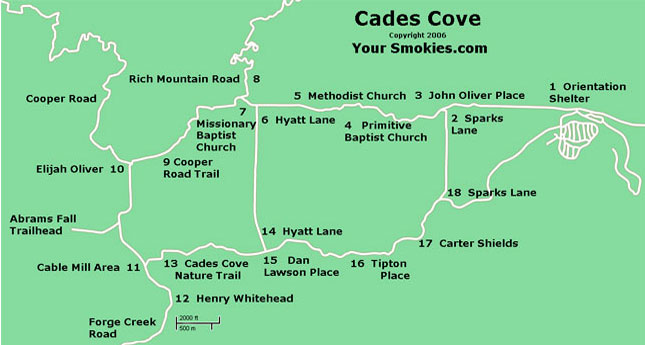
The 11 mile Cades Cove Loop Road is a single lane paved road which only allows 1 way traffic, but has 2 gravel roads bisecting the loop: Sparks Lane and Hyatt Lane one of which Spark Lane which will be closed on September 2nd and if all goes well reopened on October 8th. During the time the road is closed to construction, hikers and bikers are prohibited from entering the road.

Temporary closure of Sparks Lane in Cades Cove will not affect Cades Cove Loop traffic.

The road is being closed to allowed replacement of existing concrete enclosed steel culverts to larger capacity concrete box culverts to carry the flow of both Rowans Branch and Cooper Branch underneath Sparks Lane.

The larger capacity culverts being installed in Spark Lanes will reduce washouts from large rainstorms and runoffs as well as allowing fish in both the Cooper Branch and Rowans Branch to more easily move up and down the creeks.

U.S. Fish and Wildlife Service has given a $50,000 grant toward the $194,400 project since this construction project in the Great Smoky Mountains national park will benefit the habit of the fish located in Cades Cove.

Sparks Lane commonly sees only a few dozen cars an hour during peak times using to road to either cut their trip around the Cades Cove Loop shorter or to double back to do the back end of the Cades Cove Loop again.

Monday, August 25, 2008

Park Service denies reports that an aggressive black bear was shot near Cades Cove

Although 3 separate hikers claimed that they were told by a ranger that an aggressive black bear was shot and killed near Great Smoky Mountains national park backcountry campsite 10, officials from the national park service deny the hikers accounts.

According to the park service they are still looking for a bear that caused damage to the Mt. Collins shelter but as of yet have been unsuccessful in their quest to find the problem black bear.

Backcountry campsite 10 is on the Russell Field Trail has been closed for extended time due to aggressive bear behavior. The Russell Field Trails major trailhead Anthony Creek Trail starts less than 1-1/2 miles downhill in the back end of the Cades Cove Picnic Area near the Cades Cove Campgrounds.

Sunday, August 24, 2008

Reports of another Aggressive Bear Shot in the Great Smoky Mountains National Park.

Unconfirmed reports came in of a black bear that was shot and killed by a national park service ranger after it acted aggressively near backcountry campsite 10 on Russell Field Trail.

3 separate hikers along the Appalachian Trail made identical claims that a National Park Service Ranger told them that a black bear started acting aggressively toward the ranger who shot and killed the bear near the backcountry campsite which has been closed for a few weeks.

If correct, this occurrence of yet another aggressive black bear in the Great Smoky Mountains National Park took place less than 2 miles from where I was personally stalked by a medium sized black bear.

While the wild boars have been more brazen than ever before in the Great Smoky Mountains national park, it unfortunately seems as though the black bear might be as well.

Even with the latest incidents people planning on coming to the Great Smoky Mountains National Park must understand that is and extremely safe place to recreate and most serious injuries or deaths are a result of car accidents and drowning.

Reports of another Aggressive Bear Shot in the Great Smoky Mountains National Park.

Tick bites and yellow jacket stings should be for more of a concern for backcountry hikers and campers than an attack by a wild animal. By following basic camping and hiking safety rules you will protect the environment, the wildlife that inhabits the park and everyone in your group.

Further information and confirmation to follow.

Tuesday, August 19, 2008

Park rangers shot and killed the right bear in the GSMNP

National Park rangers shot and killed a black bear that was suspected of attacking a small child in the Roaring Fork section of the Great Smoky Mountains national park outside Gatlinburg Tennessee which was in fact the right bear based upon the necropsy performed at the University Of Tennessee College Of Veterinary Medicine.

Inside the bears stomach content part of the kids' sneaker who was attacked was found conforming the identity of the black bear. Before park officials shot the bear they had a description of the black bear by size and when they observed the bear, it exhibited unusually aggressive behavior towards them.

Black bear attacks are rare in the Great Smoky Mountains national park and are normally related to food incidents or when instigated intentionally or not by park visitors. In this case the black bear was unprovoked and there was no food present.

Monday, August 18, 2008

Peak tourist season in the Great Smoky Mountains national park

It's fantastic here in the Great Smoky Mountains, everything is green and lush, the days are long and warm, and the nights are cool and filled with the sounds of critters of all types and amazing as it may seem, the crowds are not here. What a great time to take a vacation in the Great Smoky Mountains!

Dropping gas prices have helped the tourism industry pick up a little here in the North Carolina and Tennessee Smoky Mountains but there are still many places you can take a break from the crowds and breath in peace and quiet and just feel the world slow down a little and life get just a little bit better.

I am fortunate that I get to spend so much time in the backcountry of the Great Smoky Mountains national park - on average 7 days a week. With all that time checking the peaks and valleys of the national park section by section I know the park well and from what I see, it has never been a better time to pack your bags and spend sometime in my favorite biosphere.

Frontcountry campgrounds in Smoky Mountains and backcountry sites in the Great Smoky Mountains national park are virtually empty, even shelters have plenty of room. The only issues with camping right now is the difficulty in finding water at some campsites and shelters because of this years drought and some bear activity has closed some backcountry campsites.

Hiking trails in some sections of the park are deserted and even in the more popular areas in the GSM national park where people hike such as along the Appalachian Trails (AT) I can go for 5 or more hours without seeing a single person.

Because it is so quiet here, I am seeing more wildlife than ever before in the same places as I have been hiking for years. Wild blueberries and blackberries are ripe and a ready for picking and even along trails you just need to reach on out for a quick snack while taking in the beauty of the park.

Drive down the parkway in Pigeon Forge Tennesseeor in the heart of Asheville NC and you will see the crowds and line are small and the parking is easy. If any summer was the time to come to the Smoky Mountains, this is the summer!

While this year's drought is causing real hardship for locals in the Smokies especially in Western North Carolina and there doesn't appear to be a break in sight, it does mean great weather in the Smokies for those looking to enjoy the great outdoors.

A further bonus of this year's wet spring and now dry cool summer is that the fall colors in the Smoky Mountains which start in September and run through October and end around late November are predicted by experts to be better than normal. A quick cool snap in the next few weeks will push them over the top.

Local businesses are looking to make up for a slow start to the tourist season - so can you say "bargain"?

What are you waiting for? What aren't you here? If you see me on the trails be sure to say hi!

Wednesday, August 13, 2008

Close encounters of the Black Bear kind in the Great Smoky Mountains national park

Being attacked by a black bear while hiking or camping in the Great Smoky Mountains national park has never been a fear that I have had even though I spend on an average day more than 8 hours deep in the Backcountry of the GSMNP with no one else around.

Monday's black bear attack on a small child in the Great Smoky Mountains national park did have me thinking while I was hiking from Lead Cove near Cades Cove up to the Appalachian Trail and down Eagle Creek Trail and back a 20 plus mile hiking trip. Besides a group of 5 teenagers near the AT I saw only one other person in the whole 10-1/2 hours I was in the woods.

Blackberries and blueberries are ripe for picking in the higher altitudes and made for an excellent snack after lunch and late in the afternoon. Blackberries and blueberries are both sought out and eaten by black bear so I was alert to their potential presence as well as the potential for snakes in the higher brush. I did in fact find a snake hiding in the brush near the Spence Field Shelter but there were no black bear to be seen.

On the final stretch back to my car on the last quarter of the Lead Cove Trail a little adventure was thrown my way. Being tired form hiking so long and working my way down hill with the aid of my walking sticks as dusk was setting in I had no interest in photographing an more birds, flowers and insects, I just wanted to get home.

While I normally am very quiet when walking in the woods I must have sounded like a herd of buffalo. I was paying more attention to the trail so I would not trip over any rocks than what was high in the trees - a mistake.

While rounding a blind curve I could see that the trail was clear but missed the fact that less than 40 feet from me a mother and her 2 cubs were up in a tree to my right. A loud grunt and the sight and sound of the 2 of them scrambling down the tree and into the ravine startled me and woke me up to the fact I had better pay more attention.

2 turns on the trail later I saw and heard a black bear in the distance to the right of me. He looked large but not full grown and ran further down the trail ahead and crossed in front of me and went up a hill to the left of me.

As I continued downhill his movement matched mine about 200 feet away from me. When I stopped he (or she) did as well and when I turned to walk back up the trail the was a black bear on the trail 50 or 60 feet away from me who got startled and ran into the brush. I turned around and headed back down the trail even though the bear to my left keep following me crashing through the brush.

Another 200 yards down the trail the bar decided to come towards me crossing the stream and towards the trail. At this point I put my emergency whistle in my mouth had pulled my tripod out of my large pack which I decided to leave on and extended it to be a defensive weapon and picked up some large rocks and started banging them together as he came up the creek bed onto the trail. The bear turned to me look startled and fled to my right climbing the hill and watching me behind brush. As I continued downhill I keep looking behind myself to watch the bear which finally lost interest and stayed up in the brush.

While I was not scared, I was concerned and followed the black bear safety rules understanding I could not outrun or outclimb and attacking black bear. If the other bear was not behind me, I would have not gone downhill towards the bear that was tracking me but would have exited the trail taking the Finely Cane Trail back to my car.

Tuesday, August 12, 2008

Black Bear attacks Child and injures father in Great Smoky Mountains national park

A black bear attacked and injured a child in the Roaring Fork area of the Great Smoky Mountains national park just outside the city of Gatlinburg Tennessee yesterday evening.

Evan Pala the 8 year old child who was attacked by the black bear is from Boca Raton Florida was about 1,000 feet north of playing along Le Conte Creek where it has been reported the child was attacked twice by what was probably a 55 pound yearling male black bear.

Evan Pala sustained puncture wounds along with non-life-threatening cuts and scratches and the boys father John Pala also sustained some minor injuries himself while he was driving the Black bear away from his child with sticks and rocks.

The injured child and his father were both transported to Fort Sanders Sevier Medical Center in Sevierville TN by a Gatlinburg Ambulance for treatment.

Great Smoky Mountain national park rangers found a bear that matched the father's description that was acting aggressively toward them so they shot and killed the black bear which has been transported to the University of Tennessee Veterinary Medical Center where it can be determined if this is the bear that attacked the child.

Black bear attacks in the Great Smoky Mountain National park are extremely rare although black bear encounters happen every day on the park. Though I travel extensively on the front country and backcountry of the park, other than on the Cades Cove Loop I seem to have the most bear encounters on average in the Roaring Fork Area.

To reduce your chance for an unpleasant bear encounter or attack by a black bear in the Great Smoky Mountains national park it is a good idea to follow black bear safety rules.

Recent Bear attacks in Great Smoky Mountains National Park

Sunday, August 10, 2008

Little River Road in Great Smoky Mountains National Park Closed

A head on collision between a van and a car has closed the Little River Road in both directions just west of the Elkmont campgrounds in the Great Smoky Mountains National Park.

head on collision between a van and a car has closed the Little River Road in both directions just west of the Elkmont campgrounds in the Great Smoky Mountains National Park
Expect that Little River Road will be closed until at least 11:00 am and use 321 as an alternate road.

Person being treated by Gatlinburg EMT
At least 1 person was treated at the accident scene by Gatlinburg EMT.

Wednesday, July 30, 2008

Water Wonders Workshop in the Great Smoky Mountains national park

Ready for some exciting and educational summer fun in the Great Smoky Mountains national park? Well this Friday and Saturday August 1st and 2nd you can be wading on a stream in the Great Smoky Mountains national park alongside a biologist from the University of Arkansas Dr. Andrea Radwell to discover the glory of the biodiversity of the Smokies.

This exciting chance for you to explore the Smoky Mountains will take place from 10 am to 3 pm at the Twin Creeks Science and Education Center in the Roaring Fork section of the Great Smoky Mountains national park next to Gatlinburg Tennessee.

Water Wonders Workshop in the Great Smoky Mountains national park

Bring some waders, boots or an old pair of sneakers and prepare to get down and dirty and a little wet while you learn about stream sampling while you search for water mites, other invertebrates including gooey and interesting things in the streams which you will get the chance to study up close for yourself.

Can't wait like me to do this? IF so RSVP Heather MacCulloch at Discover Life in America if you'd like to participate in the Water Mite Workshop by calling (865) 430-4756 or emailing: Heather MacCulloch at Discover Life in America.

Friday, July 25, 2008

Child injured in the Great Smoky Mountains national park airlifted to UT

A small child from Coweta county Georgia was injured in the Great Smoky Mountains national park early this evening with injures serious enough to require that the child be transferred from a Gatlinburg Tennessee ambulance in the Sugarlands Visitor Center to a UT Lifestar helicopter for air transport to the hospital.

An unconfirmed source told us that the injuries occurred in or around a camp fire causing the child to be burned in the Elkmont Campgrounds.

Child injured in the Great Smoky Mountains national park airlifted to UT

Fortunately from what we saw the child was breathing on its own seemed quite calm when being transferred from the Ambulance to the waiting helicopter.

Wednesday, July 23, 2008

Foothills Parkway Closed due to Fire Started by Lightning

Foothills Parkway East near Cosby Tennessee is now closed due to a wildfire created by lightning from a storm this Monday. At this point the fire is now contained but the road is still closed.

Foothills Parkway Closed due to Fire Started by LightningDue to last nights storm you can expect that there can be downed trees in the Great Smoky Mountains national park and the surrounding area. There may be possible closures of some of the hiking trails and roads in and around the GSMNP so drive carefully and hike or ride horses with the understanding that a trail may be impassable and you may have to return the way you hiked in.

Tuesday, July 22, 2008

Air quality issues plague the Great Smoky Mountains region and the GSMNP

The past week air quality issues caused health warnings in the Great Smoky Mountains region and the Great Smoky Mountains National Park due to elevated ozone levels.

The air pollution levels were so high in the Smokies, that it I was concerned for my own health and was unable to hike my normal 10 -15 miles a day in the GSMNP for 2 days in the past week. Even though I am extremely healthy, I did not want to exert myself and excessively expose my lungs to the irritating and damaging effect of the ozone.

The cart below shows actual readings taken from within the Great Smoky Mountains national park near the Cades Cove, Townsend and Maryville area at the Look Rock weather observatory.

Air quality issues plague the Great Smoky Mountains region and the GSMNP

Click on the chart above to see a full size image.

The photo below was taken on Sunday at the Hemphill Bald in the Cataloochee section of the Great Smoky Mountains national park near Maggie Valley North Carolina. You can see the excessive unhealthy haze created by the air pollution that not only causes poor visibility, but is a health risk especially to the young, old or unhealthy.

Hemphill Bald in the Cataloochee section of the Great Smoky Mountains national park

Not only is the ozone level in the Great Smoky Mountains increased due to the coal burning power plants, the sulfur dioxide pouring into the atmosphere is also acidifying the Great Smoky Mountains. The acid rain is affecting the plants and animals that inhabit the Great Smoky Mountains national park and it slowing killing the fish and other amphibians in the higher elevations and working it way down to the valleys.

As we will come to depend more and more on electricity for power, the level of dangerous pollutants in the air will increase further damaging the delicate balance in one the world's most important biosphere: The Great Smoky Mountains National Park unless drastic measures are taken.

Thursday, July 17, 2008

Blackberries and blueberries in the Great Smoky Mountains national park

The summer days are long and the weather is awesome here in the Smoky Mountains and right now throughput the Great Smoky Mountains national park ripe blueberries and blackberries can be found in the lower elevations and they are working their way up.

Visitors to the Great Smoky Mountains national park are allowed to pick fruits and berries for their own personal consumption. You are not allowed to pick plants, or harvest Smoky Mountains delicacies such as ramps or Ginseng as picking these plants is not only illegal it reduces its already precarious population within the park.

Black berries should be picked when all dark and slightly soft for the best flavor. Blackberries has varying degrees of thorns so be careful picking berries and please only take what you will immediately consume and don't damage or cut the plant.

Blackberries and blueberries in the Great Smoky Mountains national park

Since the berries are ripening, be careful that bear who also loves these summer treats are not close by and that if you are walking into tall grass or weeds you don't steep on either a copperhead or rattlesnake which can be hiding in the undergrowth.

If you did go into brush make sure that you check yourself for ticks as ticks are in season on the Smoky Mountains.

Wednesday, July 16, 2008

Accident with injuries at Oconaluftee Farm Museum in Great Smoky Mountains National Park

A ride in the field at the Oconaluftee Outdoor Farm Museum by the Oconaluftee Visitor's center at the Cherokee entrance of the Great Smoky Mountains national park went horribly wrong when the driver somehow ended up in a drainage canal.

An occupant on the back seat of the car had injuries serious enough to require being airlifted by helicopter to a nearby hospital while another occupant of the car was taken by ambulance to a hospital.

occupant on the back seat of the car had injuries serious enough to require being airlifted by helicopter

Luckily no other cars or bystanders were injured in this completely avoidable accident and traffic flowed smoothly on Newfound Gap road even though there were almost a dozen park, rescue and police vehicles and flat bed tow trucks at the scene which gave officers a change to use brand new forensic Nikon equipment to investigate and document the accident.

brand new forensic Nikon equipment to investigate and document the accident

The driving of cars or any other motor vehicles off of designated roads and in fields is prohibited in the Great Smoky Mountains national park and presumably the driver of the vehicle has been issued a citation for at least this offense.

Saturday, July 12, 2008

Air quality alert issued for the Tennessee Smoky Mountains today.

A code orange air quality alert for increased ground level ozone has been issues for the following counties/areas in Tennessee Smoky Mountains:

  • Anderson
  • Blount
  • Cocke
  • Grainger
  • Hamblen
  • Jefferson
  • Knox
  • Loudon
  • Roane
  • Sevier
  • Union

This warning is mostly directed persons who are extra sensitive and they may experience health effects from the high ozone levels. The general public should not be effected by may wish to restrict heavy exertion outdoors and limit exposure.

The Great Smoky Mountains national park is predicted to have moderate air quality today but is expected to deteriorate to "unhealthy for sensitive groups" tomorrow in both North Carolina and Tennessee.

Thursday, July 03, 2008

See the July 4th Salute to veterans in Cherokee North Carolina

The Unto These Hills drama will honor fallen heroes in special presentation this July 4th with some of the proceeds of the ticket helping the family of NC State Trooper Shawn Blanton who was tragically killed in the line of duty this year.

The salute to veterans will start at 7:00 pm and will include a special presentation recognizing our nation's veterans and local warriors by Lewis Harding, retired United States Air Force and Chairman of the Cherokee Historical Association Board of Trustees. After the presentation the "Unto These Hills" show choir will perform a musical tribute.


See the July 4th Salute to veterans in Cherokee North Carolina

The Eastern Band of Cherokee Indians fought bravely in both world wars, the Korean War and the Vietnam War. Since the First World War more than 47,000 Cherokee have served their country in times of war. Cherokee Civilians have helped as well during times of war by manufacturing war supplies and the purchase of war bonds.

Unto These Hills drama

Young and old will love the Unto These Hills drama about the history of Cherokee people which then starts a 7:00 pm. This outdoor drama has been seen and loved by the millions who have seen this spectacular outdoor drama that has been running continuously for 59 years!

The Unto These Hills drama runs only during the summer months Monday through Saturday starting this year in June and ending on August 30th. There is always a preshow at 7pm and the main even begins at 7:30 pm.

Reserved seating is only $20 for adults and $10 for youth. For General Admission adults tickets are $18 and for children from 6 -13 the price is $8. Children under 5 admitted free with a paying adult.

Special discounts for Unto These Hills are available for groups and you can get a 20% discount of you purchase ticket packages to two or more events and attractions. Call (800)438-1601 for further discount information.