Friday, October 26, 2007

Tennessee cities Alcoa and Maryville temporarily lifted mandatory water restrictions

Finally streams and even the Little River in the Tennessee Smoky Mountains are flowing at more normal levels since the rain from the past few days allowing the cities of Maryville and Alcoa TN to have temporarily lifted mandatory water restrictions.

By no means does this mean that we are out of the woods with the most extreme drought that the Smokies have seen in more than 100 years. Other areas in the Smokies especially in North Carolina are still in deep trouble with their water with no emanate solution to the water issues many municipalities are having.

Monday officials are going to check the level of flow in the Little River to see if they need to put the water restrictions back into effect. Regardless of the results of Monday's river flow evaluation, the city of Alcoa is determined to have an emergency source of water and is already running water lines into the Rockford area.

Due to the exceptional conservation job residents have done, the water conservation goals were not only meet but exceeded and Kenny Wiggins who is the director of Alcoa Public Works and Engineering stated "We appreciate the cooperation and support of our residents and businesses during this extremely dry weather".

Thursday, October 25, 2007

2007 Fall Leaf Season Peak in the Smoky Mountains to start this weekend

The Smoky Mountains leaves has been changing from dark greens to yellows and reds for the past month ushering in the peak leaf season and bringing in hundreds of thousands of leaf watchers a week to the Smoky Mountains of Tennessee and North Carolina. Peak leaf season in the Smokies should last for weeks deep into November and the colors worth the trip.

I have watched the all the leaves of a tree that were dark green turn into the same bright yellow color in the past 3 days. I have logged in almost 1,000 miles in the past week traveling all throughout the Smokies to observe the changes and watch the fall colors spread across and down the Smoky Mountains. What were only isolated patches of colored autumn leaves is now bursting forth as riots of colored leaves in the trees and bushes all throughout the Smokies.

This year's unusual weather in the Smokies has fall leaf aficionados scratching their heads. Some trees turned colors very early and are some cases such as poplars and a few maple trees the leaves had little vibrant colors other than tans, dark yellows and browns. Now it seems someone has turned up the volume as colors are bursting for the everywhere!

Dogwoods and some bushes in the mountains and valleys of the Smoky Mountains have show flame reds as early as the first week in September and are still hanging on in most of the Smokies.

What is clear is that the peak season won't just be for a week or 2 with one short burst of colored leaves, but with colors maybe not as brilliant as some years but with busts lasting weeks.

fall colors in the Smoky Mountains

This picture was taken a week ago in the Roaring Fork section of the Great Smoky Mountains National Park in Gatlinburg Tennessee on the hiking trail leading up to Rainbow Falls. This was the first example of vibrant colors that started to show in maple tree leaves. Now the maple trees are starting the heavier pinks, reds and yellows and the best is yet to come!

Fall colors in the oak trees are just starting to kick in as well. Normally every leaf on the tree will change colors in one heavy burst of color but this year it seems more drawn out with deeply colored leaves and green leaves on the same tree.

What I love right now is that you can see great fall colors right now and still get to have that green feeling with plenty of fully green leafed trees further enhancing the colors of the leaved that are putting on their annual fall show of color.

Plenty of color can be found in the high altitudes around Clingmans Dome and all through out the Newfound Gap Road (441) from North Carolina all the way through to Tennessee.

Make use of the pullouts along the side of Newfound Gap Road in the Great Smoky Mountains National Park to photograph the colors and the clouds coming up through the trees that give the Smoky Mountains their name. The colored leaves mixed in with the green leaves makes for a great color contrast in any landscape pictures you take in the next few weeks.

Areas such as Cades Cove TN are great for taking a leisurely ride or pictures with rolling fields with deer scampering around ending in a wooded tree line and surrounded by the Smoky Mountains with splashes of color everywhere. Early morning from 8:00 - 9:30 or afternoons from 6:00 pm on is best for observing animals and the lighting is great for pictures.

Plenty of animals and birds can be seen throughout the park but be advised that this is bear season with the black bear in the Smoky Mountains being very active. Just follow the black bear safety rules and you will be fine - and maybe get the picture of a lifetime!

While it is more crowded in the Smoky Mountains during leaf season than most other times, it is not unbearable. Although traffic can move slowly in hot areas such as Cades Cove Tennessee, the Pigeon Forge Parkway or at the Biltmore in Asheville North Carolina, it is worth every moment that you spend here in the Smoky Mountains during the best of the fall colors.

Here is a great way to see what is happening with the colors in the trees throughout the Smokies, take a look at our Smoky Mountains Web Cam page!

Smoky Mountains leaf season as a must see for anyone who enjoys the colors of autumn and there are still cabins available for rent in the Smokies and hotel and motel rooms to be had so what are you waiting for?

Wednesday, October 24, 2007

Rain brings little relief to the Smoky Mountains.

Although it has been raining in much of the North Carolina and Tennessee Smokies from last evening until this morning it is too little to late to make much of a difference.

High winds and warmer temperatures throughout the Smoky Mountains yesterday morning turning into scattered light rain in the afternoon and the moderate rain into and throughout the night.

Since rainfall in the Smokies has been dramatically light this year as a result of the drought the Smoky Mountains region is suffering, branches and leaves that would have normally fallen throughout the course of stormy weather the past few months all seem to have fallen in the past 2 days.

branches in road

Since so many branches and leaves have fallen throughout the night drivers, hikers and horseback riders must pay extra attention. Some of the tourist to the Smokies who normally don't have to deal with wet leaf litter on the road may not realize how slippery and dangerous leaves on the road can be - especially on mountain roads.

Hikers must also pay attention when hiking on trails as there is lots of fresh leaf litter on hard packed earth. Mix in exposed tree roots, slippery rocks and wet leaves on a trail and hiking can be like walking on a sheet of glass and the stepping onto a banana which can spell disaster - especially on steep trails.

People riding horses may also have to contend with downed branches across horse trails that can block a trail off and the leaves can make for slippery footing even for the most sure footed horse.

Experts in Western North Carolina claim that even though a few showers in the past week may have dampened the ground and made many small streams and rivers flow again, it is not enough precipitation to properly percolate into the ground. At the current rate of water usage imbalance, hundreds of thousands of people in North Carolina can expect severe water issues or an interruption of water services if there are no interventions within the next 100 days.

According to the report sent to the North Carolina State Water Infrastructure Commission conservation and any normal rainfall which can be counted on may not be enough. Communities in North Carolina are already examining if they need to buy water from neighboring towns and cities, start even more severe conservation and restriction programs and maybe starting to use water from the last of the unused reservoirs.

The water shortage problem may be further complicated by the predicted light and dry weather meteorologists are predicting for the Smoky Mountains this winter.

Monday, October 22, 2007

Black bears are very active in the Great Smoky Mountains National Park

Although there have been no recent attacks by black bear in the Great Smoky Mountains Nations Park (GSMNP), some visitors are pushing their luck given how active the black bear are in this the most active bear season of the year.

The best way to handle yourself when you see a black bear is to stay as far away as possible and never let the bear think that you are a threat to the bear or its cubs which may be close by and out of your sight. You should however act as a threat of you can not get away and are about to be attacked by a bear.

Black bear in a tree

Fall season in the Great Smoky Mountains National Park is usually a very active bear season which is a treat to the Millions of visitors who come to visit the park and hopefully get a glimpse or even get to take a picture or shoot video of the symbolic icon animal of the Smoky Mountains.

In the fall, the black bear in the park are in a race against time trying to gather as much food as possible before they slow down and become inactive for the winter. Black bear in the national park don't hibernate in caves during the winter as for all practical purposes there are no caves in the national park other than a sealed off cave in Cades Cove and 2 caves in the White Oak Sinks area of the park between Tremont and Cades Cove.

Black Bear in the GSMNP instead nest in hollows of trees or in a hollow tree. Bears can most often be seen high up in trees rather than on the ground. The tree in the National Park most favored by the black bear are oak trees both for the acorns they provide as food and for the shelter the older large oak trees provide to the bear.

The black bear in the fall typically eat as many nuts, berries, grasses and forbs and insects and other animals including carrion it can in an attempt to fatten up and can put on as much as 4 - 5 pounds of winter weight a day.

black bear warning sign

The female black bears will winter pregnant and the size of a litter is often dependent to the volume and quality of food the black bear acquires during the fall active season. Black bears typically have 2 or 3 cubs in a good year and just 1 or no cubs at all after a year with a limited or harder harvest.

This year's drought which has heavily affected the Smoky Mountains and the natural food stock of the black bear so the resident bears are very active in order to find the food that they need. Just don't get between a hungry bear and its food!

One of the most common questions visitors to the National park ask me is "Where can I find the most black bear in the park?" Traveling extensively through the backcountry and developed areas in both the North Carolina and Tennessee sections of the National Park I have found that the best areas of the national park to find a black bear are: The Roaring Fork section of the park by Gatlinburg Tennessee, Cades Cove typically between Sparks Lane and Hyatt Lane in the edge of the woods, backcountry areas between Cosby TN a Big Creek NC, and along the Gatlinburg Bypass on the way to Pigeon Forge. This bypass referred to as the spur will often have bear walking right across the road.

This week I have already counted 22 black bear in the Great Smoky Mountains National Park:

  • 8 along the road leading into the Roaring Fork Area before the Ogle Cabin
  • 1 on the old Sugarland Trail between Roaring Fork and the Sugarlands
  • 2 in the Greenbrier section on trail along the way to campground 32
  • 2 in Big Cataloochee NC on the Boogerman trail near the stone walls
  • 1 in Big Cataloochee NC in the back field near the old cemetery on the hill.
  • 1 in Deep Creek NC Parking area
  • 3 in Cades Cove area on the Scott Mountain Trail
  • 2 in Cades Cove area on the Gregory Bald longer trail
  • 1 in Cades Cove in woods off Hyatt Lane
  • 1 in Cosby TN on the Hens Wallow Falls trail at the second fork

Although I am only counting 8 bear on Roaring Fork, the same bear I have seen 9 or 10 times I only counted as 1. I can almost guarantee that if you go to Roaring Fork in the next few days early in the morning or before sunset you will see at least 3 or 4 bear.

black bear photographers

Unfortunately many people who are watching or photographing the black bear are not acting wisely chasing the bear up the side of the hill, whistling to get the bears attention or just stopping their car and parking in the middle of the road. All of these are forbidden behavior and illegal and can result in death or serious injury.

ranger for black bears

Bear jams are so common right now in the Roaring Fork area that often there are now up to 2 officers trying to keep park visitors under control so no one gets attacked by a black bear or hit by a driver paying attention to the bear and not the road.

camera phone fool chases black bear

My favorite is the foolish man pictured here who kept climbing the hill chasing a mother bear with her cubs and taking pictures with a camera phone. He lucky left without being attacked by the momma black bear that had her 2 cubs along for the feast of acorns on the ground and before the National Park enforcement officer arrived. Imagine risking death, dismemberment or arrest to take a poor quality picture with his cellphone that he will probably erase or lose within a year or so. Was it worth it?

The bear are fun to watch but please pay attention to the national park black bear regulations and safety rules!

Saturday, October 20, 2007

Severe Drought Effects Entire Smoky Mountain Region including GSMNP

The Great Smoky Mountains National Park is the driest it has been in more than 100 years and it doesn't look like that will change soon. The severe drought is affecting springs, creeks, streams, rivers and reservoirs and the plants and animals that depend on the precious water they provide.

Surrounding towns and cities are imposing water restrictions and conservation measures but these alone may not be enough. Day by day as this drought continues private wells are drying up or going bad and more homes and businesses are having deeper wells being drilled in an effort to find enough water to sustain the household or business.

North Carolina Fontana Lake low water levelTennessee Douglas Lake low water level

Pictured above on the left is the Fontana Lake area in Fontana North Carolina which is at the south end of the National Park and on the right is Douglas Lake that is just north of the park in Sevierville and Dandridge Tennessee. Not only do these lakes provide water but their dams generate hydroelectric power which serves the Smoky Mountain Region.

While these lakes are normally lowered in the wintertime by the Tennessee Valley Authority (TVA) by purposely letting water through the spillways of the dams, there is obviously no need to do so this year.

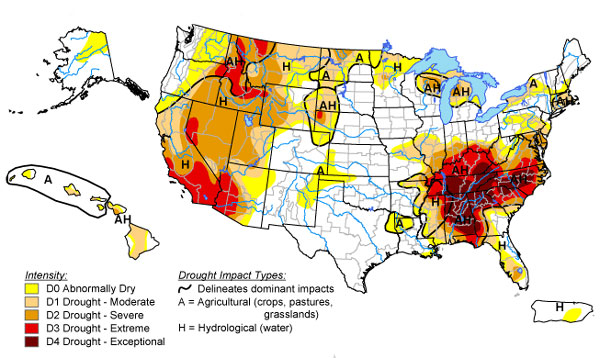
North Carolina and Tennessee areas affected by this year's drought

As seen by the chart above, not only are the Smoky Mountains of North Carolina and Tennessee affected by this year's drought, but large sections of the continental US are as well. Clicking on the map above will open a map of the drought effects as well as those regions not effect in the entire United States including Alaska and Hawaii.

Businesses as far north as Vermont are complaining the this years 2007 fall leaf season is coming late and is not as showy as normal with many trees turning brown before reaching the vibrant read, pinks and peach colors of most years.

Experts blame the lack of moisture on the phenomena and show the clear correlation in the past few years' weather warmer dryer weather and the decline in some of the forests natural food stock production for wild animals and farmed crops.

A direct effect of the drought is clearly seen in the Great Smoky Mountains National Park where normally vibrant lush creek and stream beds have been dry for months. Fishermen are working hard to find fish and obviously so are the National Parks inhabitants such as Black Bear, raccoons, birds, predatory fish and a host of other animals that depending on aquatic creatures to sustain them.

Groups such as Friends of the Smokies worked hard with a Brook Trout restoration project and between the loss of Eastern Hemlock Trees that normally shade streams to keep them cooler and help maintain moisture in the important breeding areas for fish due to an invasive pest called the Hemlock Woolly Adelgid and the current drought some of their intense well meaning effort may be for naught.

Further evidence of the drought in the Great Smoky Mountains National Park is the fact that there is a 23 mile stretch of the Appalachian Trail (AT) where there is virtually no water for backpackers and campers between the Derrick Knob Shelter and the Fontana Dam.

There are also backcountry campsites and shelters in the national park that are dry: sites 4, 5, 6, 7, 16, 21, 26, 35, 42, 113, and the hikers shelters: Double Spring Gap, Mollies Ridge, Russell Field Silers Bald and Spence Field.

As the drought continues more campsites and shelters may run dry and even with sites that have water a quart sized bottle may take 5 or more minutes to fill.

Fruits, nuts and vegetation are also sparser than normal which can lead to a difficult winter for animals that depend on these natural food stocks. Black Bears in the GSMNP are normally active in the autumn season gathering up and eating as much food stocks as possible so that they may make it through the winter where traditionally they are not active and may or may not hibernate through the winter.

While tourists love the blue skies and nice warm, dry weather we are experiencing in the Smoky Mountains of North Carolina and Tennessee, we locals are praying for a break with some sustained moderate volume rain. Heavy rainfall will just run off causing erosion and flooding but if the rain volume is relatively light and lasts for a while it can percolate better into the aquifers.

This year's drought in the Smokies won't be forgotten by locals residents and anyone visiting the region.

Backcountry campfire ban issued by National Park Service for GSMNP

Effective immediately the National Park Service has issued a ban on all backcountry campfires in the entire Great Smoky Mountains National Park (GSMNP) due to and extremely high fire danger throughout the park and surrounding areas.

This year's drought has had a tremendous impact on the GSMNP and now that the fall fire season has kicked in due to the fall leaf litter on the ground and desiccated leaves on the trees the fire danger has reached a level where a ban on back country fires in backcountry campgrounds and shelters is necessary to protect the park against wildfires.

fall leaf litter on the ground

The picture above was taken this morning on the Baskins Creek Trail in the Roaring Fork section of the National Park bordering Gatlinburg Tennessee and clearly shows that the leaves are browner and dryer than normal for this time of year and I feel that the extensive damage to the Eastern Hemlocks throughout the GSMNP caused by the invasive pest called the Hemlock Woolly Adelgid have further added to the fire danger.

Campers are still allowed to make campfires in any of the developed campgrounds found throughout the Great Smoky Mountains National Park as well as designated picnic areas as long as caution is used and fires are only made in designated fire rings and grills.

According to the GSMNP Superintendent Dale Ditmanson "The burn restriction is being placed to reduce the potential for human-caused uncontrolled wild land fires to occur within the Park's backcountry during this period of extreme fire danger and drought conditions. This is the second fire ban that has been imposed this year, which is quite unusual. Also extremely unusual is the number of free-running springs that are dry in the backcountry and along the Appalachian Trail."

High fire risk can further be reduced by visitors to the park not parking cars on any piles of leaves that may form in parking areas and on road sides as hot mufflers and tailpipes can cause the leaves to ignite. If you must smoke within the National Park boundaries make sure smoking material is completely extinguished prior to appropriate disposal. Appropriate disposal does not mean out of your car window or on a trail!

Fires in grills and fire rings in developed campgrounds must be extinguished by heavily soaking embers and ash in water to be sure that smoldering embers do not flare up.

Friday, October 19, 2007

Celebrate the On Cosby Festival in the Moonshine Capital of the world

Lots of food, fun and music, local crafts, face painting, games for the kids and more can be found in Cocke county Tennessee this weekend at the 10th annual On Cosby Festival in the Moonshine Capital of the world - Cosby Tennessee!

Picture loads of fun and being surrounded by fall colors and the beauty of the Great Smoky Mountains all for the price of parking - $2 - which goes to the local fire department.


Stick the around On Cosby Festival and you will get to see a dog show, a beauty pageant, listen to brave souls try their hands at Karaoke. At dusk on both Friday and Saturday catch the Drama at dusk!

Not only is there a car show at the On Cosby Festival, there is a display of working tractors and even a few antique running engines some of which will be grinding corn which is for sale by the bag.


Today was kids' day at the On Cosby Festival and obviously school let out early as kids were having fun everywhere - face painting and colored hair spray for the girls and the boys were running around with rubber band guns and sling shots and a few kids were in a scavenger hunt of which at some point I was the victim of some of the days tomfoolery!


Pan for gold, eat funnel cake, buy a rubber band gun or some knick knacks for your cabin or to bring back home. Great prices - good fun and beautiful fall weather - the On Cosby Festival is loads of fun and the best buy in town.

The festival runs from October 19th to the 21st and is held at the at the Cosby Welcome Center on Highway 321 - minutes from the Cosby entrance to the Great Smoky Mountains National Park.

Thursday, October 04, 2007

NC Chimney Rock State Park to have land added from Rumbling Bald Mountain

Public access to the Chimney Rock State Park in North Carolina will now be easier thanks to a 1.3 million purchase of 46 acres of land by the Nature Conservancy conservation group whose goal is to sell it the state of North Carolina so it may be added to the new Chimney Rock State Park.

Currently Chimney Rock State Park is comprised of almost 1,000 acres located in Rutherford County which was purchased for $24 million. North Carolina Division of Parks and Recreation spokesman Charles Peek is working with conservation groups in the area in order to purchase as much as 1,500 more acres to what was formerly known as Hickory Nut Gorge State Park.

Currently some areas of the park such as the popular section of the mountain called Cereal Wall which may draw as many as 100 climbers and outdoor enthusiasts on peak weekends is only assessable through private land.

Tuesday, October 02, 2007

Tennessee public smoking ban offers health, environmental and productivity advantages.

Smokers in Tennessee are now finding it harder to light up in public since the TN smoking ban kicked off this month.

Tennessee Non-Smokers Protection Act

The state of Tennessee is far behind other states that have banned smoking in public places such as restaurants, offices, hotels, retails stores and child day care centers in an attempt to make the workplace safer for employees as well as customers and to reduce the annoyance of second hand smoke.

State Health Commissioner Susan R. Cooper has stated that right now education of the Tennessee Non-Smokers Protection Act is being stressed and that the enforcement of the Tennessee Non-Smokers Protection Act will begin by early next year.

Individuals who smoke in areas where smoking is prohibited will be subject to a $50 civil fine while businesses who allow smoking on prohibited can be fined as much as $500 after 3 violations in the same year.

If you wish to report smoking in public places you can in a complaint toll free (800)-293-8228 or fill out Tennessee department of Health Non-Smoking Complaint Form.

It is surprising and upsetting to many where smoking in Tennessee was previously allowed, but most of the obvious places where smokers could enjoy a cigarette that would annoy or affect those around them have now been included in the ban.

A partial list of where smoking is now prohibited in TN is:

I can tell you that when hiking any of the numerous trails in the Smoky Mountains national park the most common litter I pick up when hiking the trails of the national park is cigarette and cigar butts. How many centuries do you think they will last if I don't pick them up?

Still desperate to still light up that cigarette and smoke in public while you are in Tennessee? There are some places that are exempt such as:

  • Bars, retail tobacco stores or other establishments that do not allow any persons under the age of 21
  • Any private club
  • Your own home or any other private residence or private motor vehicle that is not being used to commercially transport passengers to a child or adult care facility.
  • Driving a commercial vehicle and there are no passengers.
  • A business consisting of 3 or less employees as long as the smokers smoke stays in an enclosed room and does not infiltrate where customers, the general pubic or other employees would be.
  • Any open outdoor non enclosed area in a public place as long as for example you are in a tent that the sides are open, decks and open patios as long as the smoke does not infiltrate into any area where smoking under the new law is prohibited.
  • Businesses primary in the tobacco industry such as tobacco manufacturers, importers and wholesalers
  • And now for the kicker: you can smoke in long-term care facilities and nursing homes if they allow it.

Sunday, September 23, 2007

Cades Cove Motor Trail Parsons Branch Road Opening

Most of the almost 10 million people a year who visit the Great Smoky Mountains National Park never leave their cars, trucks or vans while visiting the park. While that might be a shame to some, it does keep the amount of people on the hiking trails and in campsites at a manageable level.

Some people who stay in their cars may be doing so not by choice but because of physical limitations which would not let them make use of the more than 800 miles of hiking trails in the GSMNP. Others may be fearful of what may be waiting for them in the wilds of the Smokies.

All of the roads in the national park allow motorists to not only see the splendor of the Great Smoky Mountains and the beautiful views and vistas year round, but also the chance to see deer, black bear, coyote, wild turkey and a host of other animals who make the national park their home.

I especially love driving or hiking on the unimproved road from the Big Creek Section of the park in Tennessee to the Chattahoochee area near Maggie Valley in North Carolina and Rich Mountain Road which takes you from Cades Cove into Townsend Tennessee.

Another road on my favorite list of motoring trails is the Parsons Branch Road in the far end of Cades Cove which has been closed for more than 4 years but has just been reopened after repairs and much needed improvements.

When the road reopened last Friday I was expecting there to be a big celebration possibly attended by the upper echelon of the park. Instead the road closed sign was simply removed and we drove onto this wonderful historic motor trail.

newly opened Parsons Branch Road

To keep the trail from washing out, the park service has done a wonderful job raising the road and reinforcing the road near stream crossings and placing gray rock in the drainage areas around the road to prevent erosion. Some of the reinforcement can be seen in the photograph above.

Since the road was closed for so many years and it runs through some dense forest the park service also had to cut back plenty of braches and small trees that have tried to reclaim the Parsons Branch Road. Falling tress from the last few years winter wind storms have also been removed from the roadway.

Being 3rd in line to drive on the newly opened Parsons Branch Road (obligations earlier in the day prevented me from being the first) I was surprised how little dust was kicked up by the 2 cars in front of me and how incredibly smooth the ride was compared to even the paved area of the 11 mile Cades Cove Loop.

The Parsons Branch Road runs through some mostly lower elevations with about a dozen stream crossings. On the left you will see virtual walls of rhododendrons running up hillsides that will be spectacular when they bloom in the early summer.

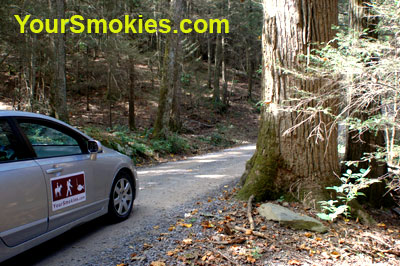
While much of what you will drive by on Parsons Branch Road is second growth forest - areas that have been previously harvested for lumber that are still some fantastic old growth trees. These trees are huge and in many cases larger than most trees you can ever see from a road in the park. One of these old growth trees is pictured below next to one of the Your Smokies cars so that you can really see how huge these trees are.

fantastic old growth trees in the the Great Smoky Mountains National Park

You will also find along the motor trail a trailhead that will take you up to Gregory Bald as well as Sheep Pen Gap. There is a small parking area here and plenty of pull offs along the way where you can take a short break and look around.

My only disappointment when driving the Parsons Branch Road Motor Trail was to find litter on the side of the road I feel that should have been picked up while the road was being worked on. I should explain that it was one RC Cola can circa 1978 and in immaculate condition just yards from the road. I just don't get how this was missed. While you are not allowed to removed artifacts, plant or animals from the Great Smoky Mountains National Park, you may remove trash as I often do.

RC Cola can circa 1978

Near the end of the Parsons Branch Road Motor Trail you will see a picturesque low flat falls in the stream bed. This is a great place to have a picnic or snap a few shots.

The road finally ends up on the Tennessee side of the infamous Tail of the Dragon and unfortunately some of the constant whine and growl of motorcycles racing close by...But that's another subject.

Motorcycle on Tail of the Dragon

If you have the time to take the Parsons Branch Road Motor Trail in the Great Smoky Mountains National Park do so - especially in spring, summer and early fall.

The Smoky Mountains leaf season to run early and short for 2007

One of the busiest tourist seasons for the Smoky Mountains is leaf season when people come to see the fall colors as they sweep through the Smoky Mountains and the Great Smoky Mountains National Park.

Since there are no less than 108 species of trees represented in the Great Smoky Mountains National Park, you are sure to see wild pallets of colors as each species of tree will change into a different color at a different time. Add in elevation changes of more than almost 5,000 feet in the park alone and you have a leaf season that is more spectacular and varied and last longer than most other regions in the Unites States.

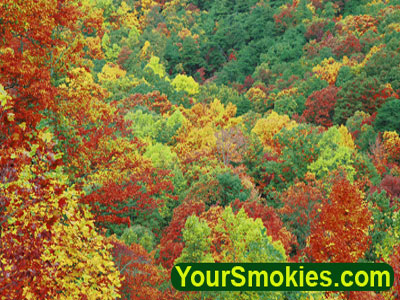
Smoky Mountains fall colors

Unfortunately the weather in the Smoky Mountains has not been very cooperative for a long leaf season this year due to extremely light rainfall. Sure it was great that you could hike in the Smokies and drive with less rain and mud, but higher moisture content in the leaves means brighter colors and longer life expectancy for each individual leaf.

In the past 3 weeks I can clearly see the lightening of dark green foliage and random burst of red, yellow and orange in the trees already. At the present it feels as though the leaves are about a week or so ahead of schedule and the weather in the Smokies is fabulous.

Smoky Mountains fall colors

Above you see a picture I took yesterday on my property in Sevierville Tennessee of the colors already changing and it looks to me that by mid October we will all be experiencing a riot of colors here.

The peak of the leaf season in the Smoky Mountains varies by attitude and moisture content of the leaves. Higher elevations in North Carolina will be the first to see the color changes and peak leaf season with lower elevations in North Carolina and Tennessee to follow.

For years I have told everyone who asked about the best time to come to be sure to catch the most color in the leaves and my answer is October to early November but if you are disappointed in the leaves colors right in front of you, you are only a short drive to another section of the Smokies where the leaves colors may be more to your liking.

If you are too early to catch the peak of the leaf season, enjoy the beautiful greens and light yellows and splashes of red. If you are to late for the peak of the leaf colors you end up missing the crowds and will usually get a cheaper rate on your hotel or cabin rental in the Smoky Mountains.

Saturday, September 22, 2007

Drought conditions still affect the Great Smoky Mountains National Park

Water is scarce in some parts of the Great Smoky Mountains National Park (GSMNP) and the Appalachian Trail which can spell serious trouble for hikers and campers who plan on normally abundant water sources.

We have seen our river and lake levels at extremely low levels this year due to an extended drought for this entire year. Springtime in the Smokies saw excessive wildfires in and around the Great Smoky Mountains National Park and surrounding state parks and forests.

Now to compound the water problems in the Smokies large areas of the park are "dry" where most or all of the free running springs won't allow any relief to parched hikers - or local animals.

In particular on the Appalachian Trail between Shuckstack Mountain north of Fontana Dam to Spence Field there is approximately a 16 mile stretch that is dry as well as the Russell Field Shelter and Mollies Ridge Shelter and backcountry sites 4, 5, 6, 7, 16, 26, 42, 113.

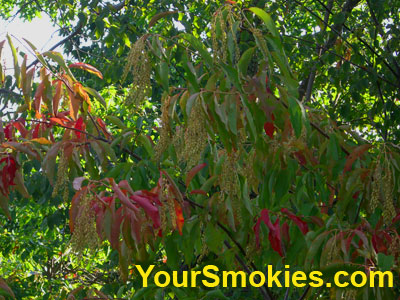
Smokies plant life

Today's gentle rain falling in parts of the Tennessee Smoky Mountains might have brought some mild relief from the warmth of the afternoon but other than making the leaves on the ground a little less crunchy while hiking and making for some nice raindrops on a leaf pictures (see above) it was not enough to elevate the issues with drying up streams, lakes and wells in both Tennessee and North Carolina.

Smoky Mountains National Park Lifts Ban on Backcountry Fires

The National Park Service has announced that the ban on backcountry fires for campers and hikers in the Great Smoky Mountains National Park has been lifted.

The fire danger due to extremely dry conditions in the GSMNP caused great concern to the park service causing them to issue a ban on backcountry fires in late August.

Fortunately due to some welcome rainfall and lower temperatures in and around the park, campers and hikers may make fires in the in any of the more than 100 backcountry sites and shelters if they practice safe campfire management.

Friday, September 21, 2007

Popular road in Cades Cove section of the GSMNP Reopens

The most popular section of the Great Smoky Mountains National Park is the Cades Cove area and today finally after more than 4 years the Parsons Branch Road will be reopened to motorists and hikers.

The Parson Branch Road

The National Park Service has worked hard to reopen the Parson branch road a one way 8 mile gravel road which takes you from the far end of Cades Cove to US 129 right into the famous Tail of the Dragon a favorite road for motorcycle riders and performance car enthusiasts.

Flooding in May of 2003 damaged the road which meandered through old growth and second growth forest and like the Rich Mountain Road also in Cades Cove, offers a motorist the closest experience to actually hiking the trails in the Smoky Mountains National Park.

Smoky Mountains National Park Superintendent Dale Ditmanson explained "When we planned and carried out the repairs we engineered in some changes to the drainage channels and stream crossings that would make it less susceptible to being washed out again, but I think visitors will find that its primitive character and its sense of solitude are still unimpaired."

The Parson Branch Road is scheduled to reopen today at noon. Keep your eye open for representatives of Your Smokies!

Friday, May 04, 2007

8K run for GSMNP will tie up Pigeon Forge Parkway Saturday Morning

The parkway in downtown Pigeon Forge will be partially closed to let the runners from the run for the Great Smoky Mountains National Park which will start at Tanger outlet mall in Pigeon Forge and then ends back at Tanger Five Oaks around noon.

The weather doesn't look like it will cooperate since there is a 90 percent chance of rain, but the event will be held rain or shine.

Expect traffic delays for this good cause - better yet come down and cheer on the runners!

Thursday, May 03, 2007

Pisgah National Forest Hiking death from fall

If only a 21 year old from Alabama who was hiking with a friend in the North Carolina Pisgah National Forest read the Your Smokies News last month where we warned hikers of the danger of hiking off hiking trials especially near waterfalls.

While trying to navigate a stream crossing above the Moore Cove Falls area just north of Looking Glass Falls he fell 50 feet to his death. He was not on a designated path or stream crossing but decided with his friend to blaze his own trail in the forest in order to get to the top of the falls.

Even though there are more than 250 waterfalls in North Carolinas Transylvania County known as the Land of Waterfalls, this is the first hiking fatality. Emergency workers in Transylvania County respond to at least 5 waterfall accidents a year even though visitors are warned to stay away from the danger zones.

Wet Rocks at Big Bradley Falls near Saluda in Polk County spelled disaster last June when a hiker fell 100 feet to his death. Waterfall related fatalities here are historically an annual occurrence.

In the Great Smoky Mountains national park there have been plenty of hiking deaths as a result of accidents around waterfalls. The 2 most dangerous waterfalls that come to mind are Laurel Falls and the Ramsey Cascades falls.

Laurel falls in easily assessable via a paved hiking path on a relatively short hike so it is extremely popular - especially with parents of younger children since many can hike to the falls without being carried. Unfortunately with slipper rocks and a steep drop off at the bottom of the falls, there have been numerous deaths.

The Ramsey Cascades falls with its trailhead located in the Greenbrier section of the Great Smoky Mountains National Park is far more strenuous with a rougher trail, higher elevations and being an 8 mile round trip hike. You are very isolated when you get to the falls making getting help and well as any subsequent rescue far more tedious and time consuming. Sadly many deaths have occurred at Ramsey Cascades falls which is one of the nicest waterfalls in the Smokies.

Hike with caution, don't blaze new trails and don't forget moss and ice covered rocks can be far more slippery than you may expect. We want you to be able to come back to the Great Smoky Mountains national park and the surrounding forests time and time again so please be careful.

Wednesday, May 02, 2007

Great Smoky Mountains National Park International Bird Conservation

The Great Smoky Mountains National Park will be holding 2 days of events highlighting International Migratory Bird Day (IMBD) and this years International Migratory Bird Day theme "Birds in a Changing Climate" examining age old practices of bird observation and being able to foretell future weather patterns.

Long before computer models and advanced weather forecasting techniques, farmers based crop planting decisions upon the movement and arrival of migratory birds. Observing the migration of birds is allowing scientists today see the how the current changes in weather patterns is affecting the birds and animal and plant species that are connected to the migration of birds.

Both International Migratory Bird Day demonstrations start at 8:00 am and will be held at the North Carolina National Park Oconaluftee Visitor Center near Cherokee this Saturday May 5th and at the Tennessee National Park Sugarlands Visitor Center near Gatlinburg on Monday, May 7th.

There will be demonstrations led by Park Biologist Paul Super as well as guided bird walks. In order to show visitors how birds are caught, examined, banded and eventually released without being harmed, Paul Super will set up delicate mist nets and demonstrate how they work.

A special visitor the Costa Rican coordinator of the Partners in Flight international bird conservation initiative Pablo Elizondo will be participating in this event. He will also be working with the Great Smoky Mountains National Park researchers into the summer in a cooperative venture allowing Pablo Elizondo to share his knowledge with park researches as well as learn some of their techniques as well.

Pablo Elizondo will be giving presentations to the pubic on bird conservation and the efforts that Costa Rica is making on conservation. For years Cost Rica has been actively protecting its natural assets acknowledging the value of their resources to its citizens as well as value of ecotourism.

Many of the resident birds of Smoky Mountains are intimately connected with Costa Rica and other Central American and Caribbean countries many thousands of miles away since they spend the winter months in more temperate climates. Clearly conservation efforts to protect migratory species need to far reaching since migratory birds pass through and inhabit many countries.

Thankfully there are international efforts working to protect migratory bird species and their unique habitats in the national parks in the United States, Canada, Latin America, and the Caribbean. The National Park Service's cooperative Park Flight Migratory Program is part of this valuable international conservation effort.

Have Your Smokies News on your web site

Now you can have the latest Smokies News on your web site by adding a free Your Smokies news crawl on your web site, blog or Myspace page.

Listed below is what the news crawl looks like as well as the html code for the link.

The HTML code:
<a href="http://www.yoursmokiesnews.com"><img src="http://feeds.feedburner.com/yoursmokiesblog.gif" alt="Your Smokies News"><br />Your Smokies News</a>

Highlight the code above in green, copy (Control C) and the Paste (Control V) into the body of your web site.

If instead you wish to link to one of the informational web pages in Your Smokies, the code is listed below:

Smokies NC and TN Weather link:
<a href="http://www.yoursmokies.com/smokies-weather-reports.html"> Smokies Weather</a>

Smokies Live Web Cams:
<a href="http://www.yoursmokies.com/smokymountainsnationalparkwebcam .html">Smokies Cams</a>

National Park Information:
<a href="http://www.yoursmokies.com/smokymountainsnationalpark .html">Great Smoky Mountains National Park</a>

Smokies Fishing Information:
<a href="http:// www.yoursmokies.com/smokymountainnationalparkfishingregulations .html">Fishing Information</a>

Friends of the Smokies:
<a href="http://www.yoursmokies.com/friendsofsmokies.html">Friends of the Smokies</a>

Link to us and let everyone know that you love the Smokies!

Monday, April 23, 2007

Knoxville TN Brushfire Visable for miles

Fire crews are working feverishly with bulldozers to keep a wildfire burning on Sharp's Ridge in north Knoxville Tennessee contained.

The fire which has been burning for hours is off of Bruhin Road and is visible from both I-75 and I-640. At this time it is believed that homes or structures are in danger of being damaged by the fire.

Tennessee is not the only state in the Smoky Mountains region having to deal with wildfires; Western North Carolina has had more than their share of fires this year with more than 2,406 wildfires which have burned no less than 10,000 acres. Last year by March only 1,300 wildfires were reported across the entire state of North Carolina. Statewide the average is 20,000 acres a year in less than 5,000 fires.

This years peak wildfire season runs is from March through May has been exacerbated by low humidity, higher than normal winds and rainfall for the year is 5 - 6 inches less than an average rainfall.

Yesterday in the Cedar Creek area of Jackson County NC there was a. 200-acre wildfire and in Haywood County NC a smaller 75-acre fire in the Cruso community which may have been started by burning debris on a legal burn day.

In Canton NC a smaller wildfire was reported by Haywood County emergency officials on Newfound Gap Road.

Friday, April 20, 2007

Alcoa Highway bypass re-opens

As fast as the Alcoa Hwy Bypass was closed due to a gas leak repairs are complete so the Alcoa Highway is now open.