Wednesday, August 27, 2008

Tragic death of kayaker in the Great Smoky Mountains national park

The body of a 27 year kayaker Isaac Ludwig was found this morning in the Great Smoky Mountains national park about 1,000 feet downstream from the confluence of the Road Prong and the West Prong of the Little Pigeon River.

Isaac Ludwig of Hartford, Tennessee and 2 other kayakers 23 year old Jared Seiler of Gladwyne, Pennsylvania and 24 year old James Donahue of Nashville Tennessee entered the Road Prong River near the Chimney Tops Trailhead and planed to kayak the rain swollen body of water and rapids on the lower section of the Road Prong and take their kayaks out of the water before they reached the West Prong.

Kayaking in the Great Smoky Mountains national park

Once in the water Jared and James very rapidly assessed that the water was running too swift and pulled their kayaks out but Isaac tragically pushed on downstream.

Isaac Ludwig was an experienced kayaker who worked for Rafting in the Smokies and did in fact have the appropriate safety gear of a life vest and helmet on while he was in his yellow Liquid Logic whitewater kayak.

Amazingly another kayaker who was unrelated to this accident lost a similar boat of the same color which was found wrapped around a tree near the Chimney Tops Picnic Area.

Smoky Mountains National Park Rangers and Gatlinburg Fire Department's Swift Water Rescue Team were involved in a search effort but the body of Isaac was found above the water line entangled in vegetation by 2 other kayakers who were running on the river which had dropped about 2 feet since yesterday.

The recovery of Isaacs body in now ongoing and is quite difficult given the surrounding terrain and the fact that there are no hiking trails near where the body is located.

While working at scout camp Isaac was taught to roll a kayak by his father at age 16 and had a driving passion for the sport. He owned at least 5 boats and by his own admission was not a stranger to having to repair damage to his boats from smashing into rocks.

Isaac had an interest in clean water environmental issues and in his free time wrote for a magazine called Sidetracked which promotes adventure sports. He was also involved in environmentally friendly kayaking products.

After car accidents, accidental drowning is one of the most common causes of serious injury or death to visitors of the Great Smoky Mountains national park.

Commonly after large rainfall many kayakers take on the streams and rivers of the Great Smoky Mountains national park. While many put in along the roadside of Little River, some will hike deep into areas to put in. For examples some as much as 5 miles or more in Deep Creek NC to brave the rapids where a swift rescue is virtually impossible.

Tuesday, August 26, 2008

R-A-I-N Spells Relief for the Great Smoky Mountains.

For the second year in a row the Great Smoky Mountains has been experiencing drought conditions not seen for more than 100 years, but finally the Smokies are getting much needed rain.

Hiking around the Smokies one can see how low water levels are and how much dryer and browner the plant life is even in higher elevation of the Great Smoky Mountains national park which can see as much as 85 inches of rain a year qualifying it as a temperate rain forest.

drought stressed leaf in the Great Smoky Mountains

Rhododendron plants leaves curl when stressed due to extreme cold or lack of water and the photo here was taken last week which clearly shows a drought stressed bush that is along the Noland Divide Trail at an elevation of more than 3,500 feet.

2 years of back to back droughts in 2007 and 2008 is taking its toll on weakened plants and may further hasten the demise of our beloved hemlocks which are waging what appears to be a losing war against the Hemlock Woolly Adelgid infestation plaguing the park and surrounding areas.

Businesses have been hit hard by 2 years worth of droughts and locals are having to deal with an unprecedented 20% hike in electric power costs from the TVA of which a large portion of is due to the lack of enough cheaper and environmentally friendly hydroelectric power.

The last thing we need to do in the Smokies is have to buy more dirty power produced by coal which is already acidifying our creeks, streams and rivers seriously effecting the higher altitude aquatic environments and choking our air with life and plant damaging ozone. Global Warming? Oh yea that too!

Add to all of this the pressure of municipalities and homeowners to maintain enough drinking and household water and you can see why were are all singing in the rain these past few days even though our beloved tourists may not be so happy as to spend more time indoors as they wanted.

A week or so of rain is not going to get us out of the woods with our drought but it sure will help.

Mouse Falls in Big Creek

The plus side is now with a nice cool snap we can have some stunning fall colors and since we are getting some much needed moisture the colors may last a little longer rather than a quick flame out. We are hoping that the 2008 fall leaf season peak will run from mid October to mid November and we are already starting to get sporadic changes in mid elevations of around 2,000 feet.

Another nice bonus to the rain is our waterfalls will be at their best instead of the measly trickles we have seen the last few weeks. Rainbow Falls in North Carolina was almost dry and even Mouse Falls in Big Creek pictured on the right was running lighter than normal when this photo was taken last week.

Temporary closure of Sparks Lane in Cades Cove will not affect Cades Cove Loop traffic.

The Cades Cove 11 mile Loop Road that circles the valley floor of Cades Cove in the Great Smoky Mountains national park sees more than a million drivers a year who get to enjoy beautiful vistas, numerous wildlife and historic buildings with peak traffic occurring in the months of September, October and November.

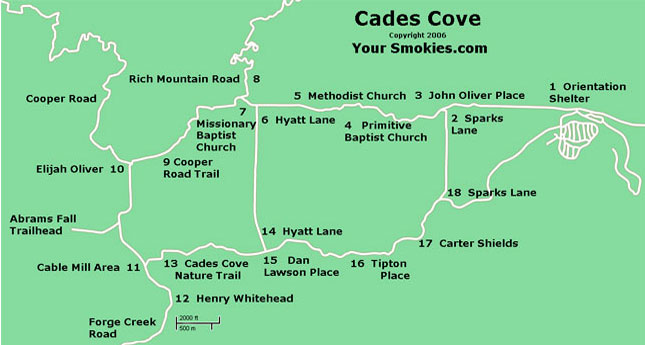
The 11 mile Cades Cove Loop Road is a single lane paved road which only allows 1 way traffic, but has 2 gravel roads bisecting the loop: Sparks Lane and Hyatt Lane one of which Spark Lane which will be closed on September 2nd and if all goes well reopened on October 8th. During the time the road is closed to construction, hikers and bikers are prohibited from entering the road.

Temporary closure of Sparks Lane in Cades Cove will not affect Cades Cove Loop traffic.

The road is being closed to allowed replacement of existing concrete enclosed steel culverts to larger capacity concrete box culverts to carry the flow of both Rowans Branch and Cooper Branch underneath Sparks Lane.

The larger capacity culverts being installed in Spark Lanes will reduce washouts from large rainstorms and runoffs as well as allowing fish in both the Cooper Branch and Rowans Branch to more easily move up and down the creeks.

U.S. Fish and Wildlife Service has given a $50,000 grant toward the $194,400 project since this construction project in the Great Smoky Mountains national park will benefit the habit of the fish located in Cades Cove.

Sparks Lane commonly sees only a few dozen cars an hour during peak times using to road to either cut their trip around the Cades Cove Loop shorter or to double back to do the back end of the Cades Cove Loop again.

Monday, August 25, 2008

Park Service denies reports that an aggressive black bear was shot near Cades Cove

Although 3 separate hikers claimed that they were told by a ranger that an aggressive black bear was shot and killed near Great Smoky Mountains national park backcountry campsite 10, officials from the national park service deny the hikers accounts.

According to the park service they are still looking for a bear that caused damage to the Mt. Collins shelter but as of yet have been unsuccessful in their quest to find the problem black bear.

Backcountry campsite 10 is on the Russell Field Trail has been closed for extended time due to aggressive bear behavior. The Russell Field Trails major trailhead Anthony Creek Trail starts less than 1-1/2 miles downhill in the back end of the Cades Cove Picnic Area near the Cades Cove Campgrounds.

Sunday, August 24, 2008

Reports of another Aggressive Bear Shot in the Great Smoky Mountains National Park.

Unconfirmed reports came in of a black bear that was shot and killed by a national park service ranger after it acted aggressively near backcountry campsite 10 on Russell Field Trail.

3 separate hikers along the Appalachian Trail made identical claims that a National Park Service Ranger told them that a black bear started acting aggressively toward the ranger who shot and killed the bear near the backcountry campsite which has been closed for a few weeks.

If correct, this occurrence of yet another aggressive black bear in the Great Smoky Mountains National Park took place less than 2 miles from where I was personally stalked by a medium sized black bear.

While the wild boars have been more brazen than ever before in the Great Smoky Mountains national park, it unfortunately seems as though the black bear might be as well.

Even with the latest incidents people planning on coming to the Great Smoky Mountains National Park must understand that is and extremely safe place to recreate and most serious injuries or deaths are a result of car accidents and drowning.

Reports of another Aggressive Bear Shot in the Great Smoky Mountains National Park.

Tick bites and yellow jacket stings should be for more of a concern for backcountry hikers and campers than an attack by a wild animal. By following basic camping and hiking safety rules you will protect the environment, the wildlife that inhabits the park and everyone in your group.

Further information and confirmation to follow.

Tuesday, August 19, 2008

Park rangers shot and killed the right bear in the GSMNP

National Park rangers shot and killed a black bear that was suspected of attacking a small child in the Roaring Fork section of the Great Smoky Mountains national park outside Gatlinburg Tennessee which was in fact the right bear based upon the necropsy performed at the University Of Tennessee College Of Veterinary Medicine.

Inside the bears stomach content part of the kids' sneaker who was attacked was found conforming the identity of the black bear. Before park officials shot the bear they had a description of the black bear by size and when they observed the bear, it exhibited unusually aggressive behavior towards them.

Black bear attacks are rare in the Great Smoky Mountains national park and are normally related to food incidents or when instigated intentionally or not by park visitors. In this case the black bear was unprovoked and there was no food present.

Monday, August 18, 2008

Peak tourist season in the Great Smoky Mountains national park

It's fantastic here in the Great Smoky Mountains, everything is green and lush, the days are long and warm, and the nights are cool and filled with the sounds of critters of all types and amazing as it may seem, the crowds are not here. What a great time to take a vacation in the Great Smoky Mountains!

Dropping gas prices have helped the tourism industry pick up a little here in the North Carolina and Tennessee Smoky Mountains but there are still many places you can take a break from the crowds and breath in peace and quiet and just feel the world slow down a little and life get just a little bit better.

I am fortunate that I get to spend so much time in the backcountry of the Great Smoky Mountains national park - on average 7 days a week. With all that time checking the peaks and valleys of the national park section by section I know the park well and from what I see, it has never been a better time to pack your bags and spend sometime in my favorite biosphere.

Frontcountry campgrounds in Smoky Mountains and backcountry sites in the Great Smoky Mountains national park are virtually empty, even shelters have plenty of room. The only issues with camping right now is the difficulty in finding water at some campsites and shelters because of this years drought and some bear activity has closed some backcountry campsites.

Hiking trails in some sections of the park are deserted and even in the more popular areas in the GSM national park where people hike such as along the Appalachian Trails (AT) I can go for 5 or more hours without seeing a single person.

Because it is so quiet here, I am seeing more wildlife than ever before in the same places as I have been hiking for years. Wild blueberries and blackberries are ripe and a ready for picking and even along trails you just need to reach on out for a quick snack while taking in the beauty of the park.

Drive down the parkway in Pigeon Forge Tennesseeor in the heart of Asheville NC and you will see the crowds and line are small and the parking is easy. If any summer was the time to come to the Smoky Mountains, this is the summer!

While this year's drought is causing real hardship for locals in the Smokies especially in Western North Carolina and there doesn't appear to be a break in sight, it does mean great weather in the Smokies for those looking to enjoy the great outdoors.

A further bonus of this year's wet spring and now dry cool summer is that the fall colors in the Smoky Mountains which start in September and run through October and end around late November are predicted by experts to be better than normal. A quick cool snap in the next few weeks will push them over the top.

Local businesses are looking to make up for a slow start to the tourist season - so can you say "bargain"?

What are you waiting for? What aren't you here? If you see me on the trails be sure to say hi!

Wednesday, August 13, 2008

Close encounters of the Black Bear kind in the Great Smoky Mountains national park

Being attacked by a black bear while hiking or camping in the Great Smoky Mountains national park has never been a fear that I have had even though I spend on an average day more than 8 hours deep in the Backcountry of the GSMNP with no one else around.

Monday's black bear attack on a small child in the Great Smoky Mountains national park did have me thinking while I was hiking from Lead Cove near Cades Cove up to the Appalachian Trail and down Eagle Creek Trail and back a 20 plus mile hiking trip. Besides a group of 5 teenagers near the AT I saw only one other person in the whole 10-1/2 hours I was in the woods.

Blackberries and blueberries are ripe for picking in the higher altitudes and made for an excellent snack after lunch and late in the afternoon. Blackberries and blueberries are both sought out and eaten by black bear so I was alert to their potential presence as well as the potential for snakes in the higher brush. I did in fact find a snake hiding in the brush near the Spence Field Shelter but there were no black bear to be seen.

On the final stretch back to my car on the last quarter of the Lead Cove Trail a little adventure was thrown my way. Being tired form hiking so long and working my way down hill with the aid of my walking sticks as dusk was setting in I had no interest in photographing an more birds, flowers and insects, I just wanted to get home.

While I normally am very quiet when walking in the woods I must have sounded like a herd of buffalo. I was paying more attention to the trail so I would not trip over any rocks than what was high in the trees - a mistake.

While rounding a blind curve I could see that the trail was clear but missed the fact that less than 40 feet from me a mother and her 2 cubs were up in a tree to my right. A loud grunt and the sight and sound of the 2 of them scrambling down the tree and into the ravine startled me and woke me up to the fact I had better pay more attention.

2 turns on the trail later I saw and heard a black bear in the distance to the right of me. He looked large but not full grown and ran further down the trail ahead and crossed in front of me and went up a hill to the left of me.

As I continued downhill his movement matched mine about 200 feet away from me. When I stopped he (or she) did as well and when I turned to walk back up the trail the was a black bear on the trail 50 or 60 feet away from me who got startled and ran into the brush. I turned around and headed back down the trail even though the bear to my left keep following me crashing through the brush.

Another 200 yards down the trail the bar decided to come towards me crossing the stream and towards the trail. At this point I put my emergency whistle in my mouth had pulled my tripod out of my large pack which I decided to leave on and extended it to be a defensive weapon and picked up some large rocks and started banging them together as he came up the creek bed onto the trail. The bear turned to me look startled and fled to my right climbing the hill and watching me behind brush. As I continued downhill I keep looking behind myself to watch the bear which finally lost interest and stayed up in the brush.

While I was not scared, I was concerned and followed the black bear safety rules understanding I could not outrun or outclimb and attacking black bear. If the other bear was not behind me, I would have not gone downhill towards the bear that was tracking me but would have exited the trail taking the Finely Cane Trail back to my car.

Tuesday, August 12, 2008

Black Bear attacks Child and injures father in Great Smoky Mountains national park

A black bear attacked and injured a child in the Roaring Fork area of the Great Smoky Mountains national park just outside the city of Gatlinburg Tennessee yesterday evening.

Evan Pala the 8 year old child who was attacked by the black bear is from Boca Raton Florida was about 1,000 feet north of playing along Le Conte Creek where it has been reported the child was attacked twice by what was probably a 55 pound yearling male black bear.

Evan Pala sustained puncture wounds along with non-life-threatening cuts and scratches and the boys father John Pala also sustained some minor injuries himself while he was driving the Black bear away from his child with sticks and rocks.

The injured child and his father were both transported to Fort Sanders Sevier Medical Center in Sevierville TN by a Gatlinburg Ambulance for treatment.

Great Smoky Mountain national park rangers found a bear that matched the father's description that was acting aggressively toward them so they shot and killed the black bear which has been transported to the University of Tennessee Veterinary Medical Center where it can be determined if this is the bear that attacked the child.

Black bear attacks in the Great Smoky Mountain National park are extremely rare although black bear encounters happen every day on the park. Though I travel extensively on the front country and backcountry of the park, other than on the Cades Cove Loop I seem to have the most bear encounters on average in the Roaring Fork Area.

To reduce your chance for an unpleasant bear encounter or attack by a black bear in the Great Smoky Mountains national park it is a good idea to follow black bear safety rules.

Recent Bear attacks in Great Smoky Mountains National Park

Sunday, August 10, 2008

Little River Road in Great Smoky Mountains National Park Closed

A head on collision between a van and a car has closed the Little River Road in both directions just west of the Elkmont campgrounds in the Great Smoky Mountains National Park.

head on collision between a van and a car has closed the Little River Road in both directions just west of the Elkmont campgrounds in the Great Smoky Mountains National Park
Expect that Little River Road will be closed until at least 11:00 am and use 321 as an alternate road.

Person being treated by Gatlinburg EMT
At least 1 person was treated at the accident scene by Gatlinburg EMT.

Wednesday, July 30, 2008

Water Wonders Workshop in the Great Smoky Mountains national park

Ready for some exciting and educational summer fun in the Great Smoky Mountains national park? Well this Friday and Saturday August 1st and 2nd you can be wading on a stream in the Great Smoky Mountains national park alongside a biologist from the University of Arkansas Dr. Andrea Radwell to discover the glory of the biodiversity of the Smokies.

This exciting chance for you to explore the Smoky Mountains will take place from 10 am to 3 pm at the Twin Creeks Science and Education Center in the Roaring Fork section of the Great Smoky Mountains national park next to Gatlinburg Tennessee.

Water Wonders Workshop in the Great Smoky Mountains national park

Bring some waders, boots or an old pair of sneakers and prepare to get down and dirty and a little wet while you learn about stream sampling while you search for water mites, other invertebrates including gooey and interesting things in the streams which you will get the chance to study up close for yourself.

Can't wait like me to do this? IF so RSVP Heather MacCulloch at Discover Life in America if you'd like to participate in the Water Mite Workshop by calling (865) 430-4756 or emailing: Heather MacCulloch at Discover Life in America.

Friday, July 25, 2008

Child injured in the Great Smoky Mountains national park airlifted to UT

A small child from Coweta county Georgia was injured in the Great Smoky Mountains national park early this evening with injures serious enough to require that the child be transferred from a Gatlinburg Tennessee ambulance in the Sugarlands Visitor Center to a UT Lifestar helicopter for air transport to the hospital.

An unconfirmed source told us that the injuries occurred in or around a camp fire causing the child to be burned in the Elkmont Campgrounds.

Child injured in the Great Smoky Mountains national park airlifted to UT

Fortunately from what we saw the child was breathing on its own seemed quite calm when being transferred from the Ambulance to the waiting helicopter.

Wednesday, July 23, 2008

Foothills Parkway Closed due to Fire Started by Lightning

Foothills Parkway East near Cosby Tennessee is now closed due to a wildfire created by lightning from a storm this Monday. At this point the fire is now contained but the road is still closed.

Foothills Parkway Closed due to Fire Started by LightningDue to last nights storm you can expect that there can be downed trees in the Great Smoky Mountains national park and the surrounding area. There may be possible closures of some of the hiking trails and roads in and around the GSMNP so drive carefully and hike or ride horses with the understanding that a trail may be impassable and you may have to return the way you hiked in.

Tuesday, July 22, 2008

Air quality issues plague the Great Smoky Mountains region and the GSMNP

The past week air quality issues caused health warnings in the Great Smoky Mountains region and the Great Smoky Mountains National Park due to elevated ozone levels.

The air pollution levels were so high in the Smokies, that it I was concerned for my own health and was unable to hike my normal 10 -15 miles a day in the GSMNP for 2 days in the past week. Even though I am extremely healthy, I did not want to exert myself and excessively expose my lungs to the irritating and damaging effect of the ozone.

The cart below shows actual readings taken from within the Great Smoky Mountains national park near the Cades Cove, Townsend and Maryville area at the Look Rock weather observatory.

Air quality issues plague the Great Smoky Mountains region and the GSMNP

Click on the chart above to see a full size image.

The photo below was taken on Sunday at the Hemphill Bald in the Cataloochee section of the Great Smoky Mountains national park near Maggie Valley North Carolina. You can see the excessive unhealthy haze created by the air pollution that not only causes poor visibility, but is a health risk especially to the young, old or unhealthy.

Hemphill Bald in the Cataloochee section of the Great Smoky Mountains national park

Not only is the ozone level in the Great Smoky Mountains increased due to the coal burning power plants, the sulfur dioxide pouring into the atmosphere is also acidifying the Great Smoky Mountains. The acid rain is affecting the plants and animals that inhabit the Great Smoky Mountains national park and it slowing killing the fish and other amphibians in the higher elevations and working it way down to the valleys.

As we will come to depend more and more on electricity for power, the level of dangerous pollutants in the air will increase further damaging the delicate balance in one the world's most important biosphere: The Great Smoky Mountains National Park unless drastic measures are taken.

Thursday, July 17, 2008

Blackberries and blueberries in the Great Smoky Mountains national park

The summer days are long and the weather is awesome here in the Smoky Mountains and right now throughput the Great Smoky Mountains national park ripe blueberries and blackberries can be found in the lower elevations and they are working their way up.

Visitors to the Great Smoky Mountains national park are allowed to pick fruits and berries for their own personal consumption. You are not allowed to pick plants, or harvest Smoky Mountains delicacies such as ramps or Ginseng as picking these plants is not only illegal it reduces its already precarious population within the park.

Black berries should be picked when all dark and slightly soft for the best flavor. Blackberries has varying degrees of thorns so be careful picking berries and please only take what you will immediately consume and don't damage or cut the plant.

Blackberries and blueberries in the Great Smoky Mountains national park

Since the berries are ripening, be careful that bear who also loves these summer treats are not close by and that if you are walking into tall grass or weeds you don't steep on either a copperhead or rattlesnake which can be hiding in the undergrowth.

If you did go into brush make sure that you check yourself for ticks as ticks are in season on the Smoky Mountains.

Wednesday, July 16, 2008

Accident with injuries at Oconaluftee Farm Museum in Great Smoky Mountains National Park

A ride in the field at the Oconaluftee Outdoor Farm Museum by the Oconaluftee Visitor's center at the Cherokee entrance of the Great Smoky Mountains national park went horribly wrong when the driver somehow ended up in a drainage canal.

An occupant on the back seat of the car had injuries serious enough to require being airlifted by helicopter to a nearby hospital while another occupant of the car was taken by ambulance to a hospital.

occupant on the back seat of the car had injuries serious enough to require being airlifted by helicopter

Luckily no other cars or bystanders were injured in this completely avoidable accident and traffic flowed smoothly on Newfound Gap road even though there were almost a dozen park, rescue and police vehicles and flat bed tow trucks at the scene which gave officers a change to use brand new forensic Nikon equipment to investigate and document the accident.

brand new forensic Nikon equipment to investigate and document the accident

The driving of cars or any other motor vehicles off of designated roads and in fields is prohibited in the Great Smoky Mountains national park and presumably the driver of the vehicle has been issued a citation for at least this offense.

Saturday, July 12, 2008

Air quality alert issued for the Tennessee Smoky Mountains today.

A code orange air quality alert for increased ground level ozone has been issues for the following counties/areas in Tennessee Smoky Mountains:

  • Anderson
  • Blount
  • Cocke
  • Grainger
  • Hamblen
  • Jefferson
  • Knox
  • Loudon
  • Roane
  • Sevier
  • Union

This warning is mostly directed persons who are extra sensitive and they may experience health effects from the high ozone levels. The general public should not be effected by may wish to restrict heavy exertion outdoors and limit exposure.

The Great Smoky Mountains national park is predicted to have moderate air quality today but is expected to deteriorate to "unhealthy for sensitive groups" tomorrow in both North Carolina and Tennessee.

Thursday, July 03, 2008

See the July 4th Salute to veterans in Cherokee North Carolina

The Unto These Hills drama will honor fallen heroes in special presentation this July 4th with some of the proceeds of the ticket helping the family of NC State Trooper Shawn Blanton who was tragically killed in the line of duty this year.

The salute to veterans will start at 7:00 pm and will include a special presentation recognizing our nation's veterans and local warriors by Lewis Harding, retired United States Air Force and Chairman of the Cherokee Historical Association Board of Trustees. After the presentation the "Unto These Hills" show choir will perform a musical tribute.


See the July 4th Salute to veterans in Cherokee North Carolina

The Eastern Band of Cherokee Indians fought bravely in both world wars, the Korean War and the Vietnam War. Since the First World War more than 47,000 Cherokee have served their country in times of war. Cherokee Civilians have helped as well during times of war by manufacturing war supplies and the purchase of war bonds.

Unto These Hills drama

Young and old will love the Unto These Hills drama about the history of Cherokee people which then starts a 7:00 pm. This outdoor drama has been seen and loved by the millions who have seen this spectacular outdoor drama that has been running continuously for 59 years!

The Unto These Hills drama runs only during the summer months Monday through Saturday starting this year in June and ending on August 30th. There is always a preshow at 7pm and the main even begins at 7:30 pm.

Reserved seating is only $20 for adults and $10 for youth. For General Admission adults tickets are $18 and for children from 6 -13 the price is $8. Children under 5 admitted free with a paying adult.

Special discounts for Unto These Hills are available for groups and you can get a 20% discount of you purchase ticket packages to two or more events and attractions. Call (800)438-1601 for further discount information.

Sunday, June 29, 2008

Native American Pow Wow July 4th - 6th in Cherokee North Carolina

The Native American Pow Wow in Cherokee North Carolina will entrain visitors with pounding drums, traditional Native American chants, Native American costumes and plenty of fancy footwork.

Cherokee Indian Smiling at the Native American pow wow

Visitors to the Cherokee Pow Wow this July 4th, 5th and 6th both young and old will have a great time watching the best native American Indian dancers from tribes near and far competing for cash prizes and bragging rights to be the best dancer or drummer in each category.

Visitors to the Cherokee Indian Pow Wow will also find native American Crafts and products and booths selling various food.

The Pow Wow will be held in the Cherokee fairgrounds and the gates open Friday July 4th at 5 pm, Saturday July 5th at 10 am and Sunday July 6th at 10 am.

Native American Costume

The dancers and drummers will make the grand entrances on Friday at 7 pm, Saturday at 1pm and 7 pm and Sunday the final grand entrance will be at 1 pm.

The following are the dancing and drumming categories and the corresponding prizes:

Women Indian Dancers ages 18-49
Northern Traditional
Southern Traditional
Jingle Fancy
1st Prize = $1,000, 2nd prize = $800, 3rd prize = $600

Teen Girls Indian Dancers ages 13-17
Traditional (Buckskin & Cloth)
Jingle
Fancy
1st Prize = $250, 2nd prize = $150, 3rd prize = $50

Junior Girls Indian Dancers ages 6-12
Traditional (Buckskin & Cloth)
Jingle
Fancy 1st prize = $100, 2nd prize = $50, 3rd prize = $25

Men Indian Dancers ages 18-49
Traditional/Straight
Grass
Fancy
1st Prize = $1,000, 2nd prize = $800, 3rd prize = $600

Teen Boys Indian Dancers ages 13-17
Traditional/Straight
Grass
Fancy
1st Prize = $250, 2nd prize = $150, 3rd prize = $50

Junior Boys Indian Dancers ages 6-12
Traditional/Straight
Grass
Fancy
Fancy 1st prize = $100, 2nd prize = $50, 3rd prize = $25

Tiny Tots Indian Dancers ages 5 and under
Compete for Day Money

Golden Age Men and Women Indian Dancers ages 50+
1st prize = $800, 2nd prize = $600, 3rd prize = $400

Drum Contests:
Northern Style
Southern Style
1st prize = $2,000, 2nd prize = $1,500, 3rd prize = $1,000

Dance Specials for the Pow Wow:
Two Step, Chicken, Smoke (2), Daniel French Memorial, Fancy Shawl, Grass, and others!!!

For those who are going to participate in the Pow Wow as contestants for the dancers there is a $10 registration fee and for the drum contestants there is $50 Entry Fee and there must be 5 in group to enter contest.

At this time we would like to thank all of those competing in the Pow Wow as well as:

Pow Wow Arena Director: RG Harris, Apache, OK
Pow Wow MC: Rob Daugherty, Jay, OK
Head Dance Judge: Troy Saunsoci, Niobrara, NE
Head Drum Judge: Aaron Hogner, Cherokee, NC
Host Northern Drum: Black Lodge Singers, White Swan, WA
Host Southern Drum: Otter Trail, Ardmore, OK
Intermission Entertainment: Tommy Wildcat

Elk in the Great Smoky Mountains national park: wild, beautiful but dangerous.

Elk have been extinct in the Tennessee and North Carolina Smoky Mountains for more than 100 years, but thanks to private funding Elk have been reintroduced in the Great Smoky Mountain national park in 2001.

These majestic animals were reintroduced into the Cataloochee section of the Great Smoky Mountain national park in North Carolina near Maggie Valley, but since Elk don't understand park boundaries they have wandered out of the safety of Cataloochee's valleys and fields and have spread into other areas of North Carolina and Tennessee.

Elk can commonly be seen along the roadside near the construction area on Big Cove Road in Cherokee North Carolina and north of the Blue Ridge Parkway along the side of the road on 441 Newfound Gap Road by the Oconaluftee visitor center in the Great Smoky Mountains National Park.

I have been told that the elk have now been spotted as far away as the Greenbrier section of the Great Smoky Mountains national park a short walking distance from the city limits of Gatlinburg Tennessee.

Elk are very large unpredictable wild animals that can easily seriously injure or kill someone without warning. Elk have no concept of park borders nor do they understand that foolish people walking up close to them with young children are offering no real threat to these wild animals, they just want to take a picture of them.

Elk in the Great Smoky Mountains national park: wild, beautiful but dangerous.

This picture above shows 2 adults walking within 50 feet of an elk lying down in the grass off Newfound Gap Road yesterday. This is the time of year when young elk calves have been just been born and are commonly hidden in grass away from predators. If there is an elk calf in the grass near this bull elk, anyone approaching the young calve could have been killed.

Since this Elk is a male and the calves are generally in the Cataloochee valleys and hills chances are there are no calves in the grass near Newfound Gap Road but these visitors had no idea of the elks habit.

elk warning sign in the national park

The wife of the man on the left was excusing her husbands illegal and extremely foolish behavior claiming there are no posted warnings. When she was advised by me of the danger her children and her husband are in and the fact that her husband can be fined, she never asked her husband or children to back away from the Elk. She also told me what he was doing was ok because the park rangers who just arrived did not tell her husband what he was doing was wrong.

There were in fact no park rangers there but a male and female park volunteer than just got off work at the Oconaluftee Visitor Center. They just stood there at the roadside and watched as people walked down off the roadside and went into the field to approach the wild animal.

When showing this and other photographs which clearly showed how close these park visitors were to the Elk to the volunteer he seemed disinterested.

As the traffic situation for the elk jam was getting worse I asked the park volunteer to radio or call in order to get an enforcement officer to the scene to protect the park visitors from their foolish behavior and work on keeping traffic flowing. He begrudgingly complied.

The Great Smoky Mountains national park Elk population has more than doubled since their reintroduction and unless better management practice are put in place and people behave responsibly - people with get injured if not die as a result of a man versus elk encounter.

It is time that the public and the park service wake up. The elk do belong in the park - this was their territory, and we as guests of the national park must behave in a personally responsible manor to protect ourselves for our own and the elks safety.

As for Elk outside of the park, this will become a more serious issue as time goes on and there will be elk versus traffic and elk versus human encounters increase along with the elk population expansion.

The area that the elk were to be introduced in needed to be set up as to safely contain the elk via physical barriers and the lack of such barriers will bite the National Park Service in the butt when the wrongful death and wrongful injury lawsuits start to occur.

Tuesday, June 24, 2008

Ticks in the Smoky Mountains can lead to Rocky Mountain Fever for Hikers and Campers.

I hike a lot in the Great Smoky Mountains national park - on average at least 10 -15 miles a day 7 days a week - year round so I am used to dealing with wildlife big and small. I have noticed that this year there seems to be more ticks in the backcountry of the Great Smoky Mountains than I have ever had to deal with before.

Though I have not found one on myself in more than a week I have removed 9 ticks from my skin and clothing this year after hiking in the Great Smoky Mountains national park. My previous record year was 6 where 3 of which were on the same pants leg in one day so obviously there is a higher concentration of ticks this year in the Smokies - or I must taste much better to them!

The ticks I picked up while hiking this year were from all over the place: Beard Cane Trail in Abrams Creek, Newton Bald Trail near Deep Creek, Grape ridge trail in Greenbrier, Hen Wallow Falls in Cosby, the field by Hyatt Lane in Cades Cove, Little Greenbrier Trail near Wears Valley, 20 mile loop trail in Twenty Mile, Hyatt Ridge in Straight Fork and one from my trunk where I keep my hiking shoes.

Smoky Mountain ticks

Every night when I get home I am sure to check myself for ticks, however all of the ticks I found on myself I found either in the field or in one case in my car while driving. While it is suggested to always wear long pants tucked into boots (some people even duct tape the pants legs), I usually wear light colored khaki shorts and long socks and look down at my legs often while hiking or check myself after going through high grass or brush.

Ticks - not black bears scare me. I moved from the northeast almost 20 years ago as Lyme's disease ran rampant up there. Lyme's disease which is spread by deer ticks kept me from camping and enjoying the great outdoors after watching fellow camper and hikers get deathly ill or disabled from the disease.

Unfortunately here in the Smokies we have a high instance of Rocky Mountain spotted fever which is spread by ticks. The key to reduce your risk is avoid areas that may contain ticks, use insect repellent, wear light colored clothing - long sleeves and long pants do help, and find and remove ticks as quickly as possible.

While there are old wives tales about tick removal, the only sure way is with the help of good tweezers. With the tweezers you can grab the head and remove the whole tick so the head does not break off and stay embedded in the skin.

You should wash the skin around the tick with an antiseptic and save the tick by placing it into a Zip loc bag and if possible freezing it with a date on the bag. If you get ill, bring the tick to the doctor or hospital so they can determine if the illness came from the tick by culturing the tick and what illness it was carrying.

The good news is that most people hiking or camping in the Great Smoky Mountains national park will never see a tick. Ticks are usually only very active in warmer weather.

Friday, June 13, 2008

2 more days left on Great Smoky Mountains national park Rainbow Trout fish out.

Today and tomorrow are the last 2 days you can catch and keep as many Rainbow Trout no matter the size in the Tremont section of the Great Smoky Mountains national park.

In order for the national park service along with the help of funding by Friends of the Smokies to restore the native Brook Trout species back into the Tremont Tennessee section of the Great Smoky Mountains national park, the Rainbow Trout must be removed. What Rainbow Trout that don't get removed will be poisoned in September.

The first day of the fish out anglers brought home more than 110 fish. As of last count mid afternoon yesterday, less than 460 fish in total have been caught during the whole fish out. This number could have been considerably higher if more fisherman showed up to take advantage of the fish out rather than fishing in other sections of the Great Smoky Mountains national park.

Here are the complete details for the Great Smoky Mountains national park Rainbow Trout removal in Tremont.

Thursday, June 12, 2008

The Spur connection Gatlinburg and Pigeon Forge will have more intense construction delays for most of June.

Expect longer delays during weekdays on the Spur - the road connecting Gatlinburg with Pigeon Forge with a shortcut that takes you into the Great Smoky Mountains national park.

Now that the construction has moved into the milling and paving phase so the road may be resurfaced during weekdays 1 lane will be closed in each direction which will cause some significant delays.

These next few weeks will be trying especially for those in a rush. Driving above the posted speed with the road surfaces being uneven is not only risking an accident with other car and construction workers, except some enhanced speed limit enforcement and hefty fines for speeders on the Spur.

Synchronized Fireflies in the Great Smoky Mountains national park in Elkmont - a huge disappointment.

Going to see the fireflies in the Elkmont area of the Great Smoky Mountains national park along with more than 1,050 other people waiting to watch the lighting bugs in the woods and fields all flash at the same time was a huge disappointment.

The shuttle service where you ride in a trolley for $1 round trip that picks you up in the Sugarlands visitor center parking lot starting at 6:00 pm and takes you right to the area in Elkmont where the firefly beetles perform nature's finest light show ran smoothly.

The area in Elkmont along the Little River in the GSMNP where the lightning bugs flash their lights to attract mates is one of the nicest areas of the park - large trees, heavy growth, huge moss covered boulders and a roaring river with many little waterfalls and pools as the river meanders along the hiking path.

The people who came to watch the fireflies - even the kids - were all courteous and well behaved and everyone seemed to be having a great time sitting in folding chairs, hiking on the trail, picnicking and playing with their kids.

When the firefly bugs really starting kicking in their light show at around 9:30 pm even people who saw it before were dazzled by the display of synchronized lights, random flashes and short periods of darkness.

Here is the huge disappointment: digital pictures and movies can not capture this awesome display! I tried everything and second time I came to see the fireflies I just tried to find the words to describe the beauty of the firefly show and it just can't be done! What a huge disappointment.

Besides this major disappointment I had to suffer, I had a great time both nights and will be sure to come out again this season to see the synchronized firefly beetles in Elkmont.

Related Smokies News Stories

Synchronized Fireflies in the Great Smoky Mountains

Tuesday, June 10, 2008

Great Smoky Mountains Fireflies a big hit drawing more than 900 visitors the first night alone!

Visitors came in droves to the Sugarlands Visitor Center near Gatlinburg Tennessee in the Great Smoky Mountains National Park shuttle to Elkmont to observe the synchronized fireflies.
More than 900 people showed up the first night of the 2 week lightning bug show and even more are expected to show up next weekend when the mating season for the firefly beetles is in full swing.
Even though the weather will be shaky for the remainder of the week we suggest that you come during a weeknight if possible to avoid the crowds who come to watch the synchronized fireflies that perform the best in the Elkmont section of the GSMNP.
Shuttles start leaving to Elkmont from the Sugarlands visitor center at 6:00 pm. The Elkmont section of the park closes to all traffic other than shuttles at 5:00 pm. You can read more about the synchronized fireflies in the Great Smoky Mountains National Park.
A side note: even though the park service has advised us to ask visitors to bring red cellophane to cover flashlights, red cellophane was provided for those who did not have their own.
By using red cellophane on flashlights people who are around you can maintain better night vision and the lights that are red are less disturbing to the lightning bugs as white lights which can keep the fireflies from flashing to their prospective mates.

Related Smokies Fireflies News Stories

Synchronized Fireflies in the Great Smoky Mountains

Monday, June 09, 2008

Missing hiking trail sign in Deep Creek NC Section of the GSMNP could spell disaster.

I hike on average 10 - 15 miles a day in the Great Smoky Mountains national park so I am pretty well equipped for anything when I go out into the woods. Luckily with plenty of daylight, a watch and a map I was to change my hiking plans and not get lost even though an important trail sign was missing in the Deep Creek Section of the Great Smoky Mountains national park.

Hiking as much as I do, I know depending on how rugged the terrain is and how many pictures I am taking I know that I average from 1.2 miles to 3.1 miles and hour uphill and 1.8 miles to 3.9 miles and hour downhill. My watch and an accurate map in the Great Smoky Mountains are my most valuable navigation aids. I also always have a compass packed just in case.

Because of the potential for heavy cloud or tree cover you can not count on being able to get getting a reading from your GPS. This can go on for minutes, hours or sometimes days. Batteries can die unexpectedly and we all know that even new electronic equipment can fail without warning or fall and break or even get lost so never hike in the Great Smoky Mountains only counting on a GPS to lead the way!

I planned on hiking Kephart Prong yesterday and go along the ridgeline and end up at the campgrounds on the cabin flats trail. Weather predictions called for a probability of rain and thunderstorms and there was limited visibility due to haze so I changed my plans while on the road to a lower elevation hike in Deep Creek.

The heat index was already at 98 degrees when I arrived at the Deep Creek Trailhead so I loaded up with 3 liters of water for myself and set out on my hike with my day pack and cameras.

There were a lot of families with kids riding tubes and splashing around in the water having a grand old time. This was a great place to bring the kids to cool off during this record breaking heat wave and the price was right: only $3 a day for a tub rental!


Missing hiking trail sign in Deep Creek NC Section of the GSMNP could spell disaster.

Working my way uphill in the heat, the trails were virtually deserted and I found myself consuming water at a rapid rate. Knowing this stretch of my trip was only 2.1 miles to the next trailhead I knew that it should take me from 40 minutes to about an hour to get there.

Since it was very hot and I was consuming water rather quickly I tried to keep my place slower than normal in oder to keep cool.

Along my hike I noticed and unmarked trail about 35 minutes along the Thomas Ridge Trail and since it was not marked I decided to take a short detour and check it out. A trail that is not marked can be a bypass which would bring me back onto the trial I was hiking.

The trail seemed more worn than most manways in the Great Smoky Mountains national park and I could see old signs of maintenance - cut logs along the side of the trial that appeared to have been cut at least 5 years ago or longer. The trail gained in elevation and veered further and further away from the trail I was on so after a half hour of hiking on this unknown trail I turned around to get back on the original trail I was on.


location of missing hiking trail sign in the Deep Creek section of the Great Smoky Mountains national park

Back on the original trail I was hiking on, I went for another 25 minutes mostly downhill now I realized that I must have passed the junction. Trying to check my position on the new 2008 Hiking Trail Map I purchased from the national park service, I could not find myself on the trial given that the new maps have removed all topographical references as well as not showing accurately details such as individual switchbacks.

With water running low (less than a liter now) I realized that I must work on finding my way out of the park and back to my car. My choice would be walk back the way I came or work on find a trail back on a more efficient loop. Without topographical information on my map I had no idea if this shortcut back would be uphill downhill or a combination of both.

I stopped, made an evaluation of where I was, listened and heard way in the distance the sound of rushing water. It can be hard to tell the difference unless very experienced between the sound of water or wind blowing through leaves. Consulting the map which does show large water features I determined I was already on the shortcut I needed to take to get back to the car.

20 minutes later I was at a marked trailhead confirming I was exactly where I needed to be. A few yards away I ran into 2 other hikers who confirmed to me when they were hiking the day before the sign was in fact missing and they also were lost as a result of the missing sign.

As soon as I returned to my car I went to the campground check in and checked the message board - no notes about the missing sign. I then went to the ranger's station and reported the missing sign.

In the winter with limited daylight and using just the new map and a compass I would have been in for a real problem as I could never have taken a chance for a shortcut - I would have had to return the way I came - a far longer trip but the only sure way I know I could have returned.

The new Great Smoky Mountains national park hiking map is terrible and I would suggest only using the National Geographic Topo map of the area. In the winter or when taking a very long hike I always depend on this map and this reaffirms this is the only map I will use out here in the backcountry when hiking in a less familiar area.

Would a GPS have worked yesterday? Maybe. There was a very heavy canopy and I may not have had the ability to get a fix. If it was winter when solo hiking is more dangerous I would have had one with me. In the winter, late fall and early spring the lack of leaves may have helped me get a fix as long as there was not heavy cloud cover and I had a clear shot of the sky.

I don't expect that this sign will be replaced with a day but I do hope that they will put a not on the bulletin board and should put notes at the trail heads around the missing sign that the sign is in fact missing.

Saturday, June 07, 2008

Great Hike today on the Cades Cove 11 mile loop in the GSMNP

Arriving early at the Cades Cove 11 mile loop today we were able to avoid all traffic for the first 3 hours as we walked along the valley floor surrounded by wildlife, flowers and the beautiful Great Smoky Mountains.

We all got to see Black Bear, Wild turkey, deer, Canadian geese and plenty of small wildflowers in the fields and woods in Cades Cove. The Black bear below was photographed this morning near the primitive Baptist Church.


Great Hike today on the Cades Cove 11 mile loop in the GSMNP

I was so glad to meet the people today who started the hike and those I have met along the way. As great as the wildlife and scenery in the Great Smoky Mountains national park is, it truly attracts very special people as well.

Next time I plan on doing another walk as a group I will give everyone more notice.

Great Smoky Mountains National park hosts synchronous firefly show for the next 2 weeks.

Starting tonight visitors to the Great Smoky Mountains national park are in for a special treat while the synchronous firefly beetles found in the Elkmont section of the park will flash their lights all in unison.
Fireflies also commonly known as lightning bugs can be found elsewhere and the Great Smoky Mountains national park has 14 species that have been identified within the park but only the species called Photinus Carolinus attract their mates with flashing lights within their bodies in a synchronous pattern.
The light given off buy the fireflies is actually a chemical reaction between chemicals within the fireflies, oxygen and an enzyme produced by the beetle. This light also known as bioluminescence is light green for most fireflies and one is bluish.
The exact timing of when it is best to observe the synchronous firefly beetles depends on weather and other condition and although the lightning bugs can take up to 2 years to mature, the light show taking place in their mating season only last around 21 days. The best guess is that this year next week will be the best week to observe the phenomena.
When watching the light show you will notice that to fireflies don't always flash in unison. You may observe different light patterns that they will make such as all the lightning bugs flashing randomly, then in waves across the hillside and then they will all flash together and all stop leaving some momentary periods of darkness.
Visitors to the fireflies should have bug spray and if you are bringing a flashlight it should have a red setting or you bring along red or blue cellophane to cover the light so as not to interfere with the fireflies and other observers night vision. Lights should be pointed to the ground and turned out in the observation areas.
Since this has become an extremely popular attraction with visitors to the park and Elkmont has limited parking, a shuttle service is in place from June 7th to the June 14th at the Sugarlands Visitor Center near Gatlinburg. Riders who take the shuttle to Elkmont pay only $1 for a round trip ticket.
Due to crowding in Elkmont and the potential for pedestrians being hit while walking back to their cars in the dark along Little River Road, no parking is allowed in Elkmont or along the road sides so if you wish to see the fireflies, you must take the shuttle from The Sugarlands Visitor Center.

Related Smokies Fireflies News Stories

Synchronized Fireflies in the Great Smoky Mountains

Friday, June 06, 2008

Join me for a Hike through Cades Cove without any traffic tomorrow morning.

Cades Cove is my favorite part of the Great Smoky Mountains national park when it is quiet and not crowded so tomorrow morning I will be hiking the 11 mile loop starting at 7:15 on Saturday June 7th. Since cars are banned from the road until 10:00 am I should be at least past the Cades Cove visitors center in the back end of the loop before the first car passes by.

I have often been asked by hikers and people who follow our news and articles if I would lead a walk as I am very familiar with the area and know most of the haunts of the black bear, deer and wild turkey which am sure we will see tomorrow morning - here is your chance to join me.


Join me for a Hike through Cades Cove without any traffic tomorrow morning.

Since it is getting warmer by the day, before too long I will not want to hike the loop in daylight as the back end of the Cades Cove Loop has no tree cover and tends to get very hot and sometimes buggy.

If you wish to walk, wear good comfortable shoes - sneakers should be OK as I am not planning on bushwhacking and the road is dry since we have not had much rain. Bring a bottle of water which you can refill at the visitor centers water fountain and by all means bring a camera.

Since I have not made any real prior announcement and this is not an official tour, it's just me letting you tag alone on one of my daily hikes in the National Park, there may be few if anyone joining me.

How will you find me? There is a parking area by the entrance of Cades Cove and I assure you, you can't miss me.

If you are interested in coming please comment back to this thread and tell me how many of you plan to come along.

Wednesday, June 04, 2008

Water problems at some Backcountry Campsites in the Great Smoky Mountains national park.

Seem like the water problems are starting again in the Great Smoky Mountains national park for backcountry campers. Last years drought in the Smoky Mountains caused serious problems for campers as there was stretch of more than 20 miles that ran dry.

So far the backcountry sites that have water problems are in the Cades Cove Tennessee area backcountry site #7 (Ace Gap) and backcountry site #4 (Kelly Gap) and in the Elkmont Tennessee area backcountry site #19 (Upper Henderson).

All three backcountry sites with water issues in the Great Smoky Mountains national park are from 1,600 to 2,900 feet in elevation and horses are allowed.

Last years water problems in the national park were more prevalent in the North Carolina side as opposed to these which are all in Tennessee.

Tuesday, June 03, 2008

No limits on Rainbow Trout in Tremont section of the Great Smoky Mountains National Park

Even though Rainbow Trout size and quantity limits are lifted on an 8 mile section of the Tremont area of the Great Smoky Mountains national park, less than 10 anglers are taking advantage of this special opportunity to help the national park and fish in one of the most beautiful areas to fish in Tennessee.

Yesterday the park recorded that 115 Rainbow Trout were caught as well as one legal sized Brook Trout in the special fishing zone that was set up where the native Brook Trout restoration will take place this September.

No limits on Rainbow Trout in Tremont section of Great Smoky Mountains National Park

Park service employees are expecting a much larger crowd this weekend so the best time to come out and enjoy the peace and quiet as well as bring home a good dinner will be during the week. There should be plenty of fish to catch as well as space for fisherman this weekend as well.

In order to take advantage of this limit free Rainbow Trout harvest to help with the Brook Trout restoration program you must register on the temporary fishing registration tent a few hundred feet from the Middle Prong Trailhead in Tremont.


Great Smoky Mountains national park fish check in

Only the Rainbow Trout in the designated area have size and quantity limits lifted. Brook Trout must be of legal size to be kept and only artificial lures with a single hook are allowed to be used to catch any fish in the GSMNP.

The reason why size and catch limits still apply to Brook Trout in the area is that prior to the national park service biologist to administer the poison to the water which will kill the remaining Rainbow Trout in September, biologists will use electro-fishing to stun and then remove any Brook Trout that they can so that these native fish can be safely held until the water is ready for their reintroduction. This is also the reason why single hooks only can be used when fishing in the area to reduce hooking mortality to the Brook Trout.

To fish anywhere in the Great Smoky Mountains National Park you must have a valid Tennessee or North Carolina fishing license if you are are 13 years old or older. You can read about this and other national park fishing regulations on Your Smokies.

Saturday, May 31, 2008

Now you can follow the excitement of Your Smokies on Twitter

Your Smokies has just the world of Twitter as Smokies Hiker and has been updating feeds on both Your Smokies News and the Your Smokies web site Hiking section.

What is Twitter you may ask? It is a free service that lets you send or receive messages up 140 characters long in real time. Now you can see where we are going and what we are doing along our adventures in the Great Smoky Mountains.

With Twitter we are updating our web sites and blogs via our PCs in our offices and laptop computers and cell phones while we are on the road. Often cell phones do not work in the Great Smoky Mountains national park, but when they do we will be sending updates.

Twitter will also give you the opportunity to respond what we write about on Your Smokies or not. Don't want to Twit? Well you can just watch our Twitter updates on the lower right hand side of Your Smokies News.

Ready to join the fun? Follow the Smokies Hiker on Twitter!

Friday, May 30, 2008

Great Smoky Mountains national park closes 2 backcountry campsites.

2 Backcountry campsites were just closed in the Great Smoky Mountains national park, the first being backcountry campsite #15 on the Rabbit Creek Trail connecting Cades Cove with Abrams Creek and the other backcountry campsite #53 in around the Thomas Divide trail intersection with the Newton Bald Trail accessible off Newfound Gap Road in North Carolina.

Both backcountry campsite 15 also know as the Rabbit Creek campsite (pictured below) and backcountry campsite 53 known as Poke Patch campsite were closed due to aggressive black bear activity and will remain closed until further notice. This can be a few days, weeks or even longer.


Great Smoky Mountains national park closes 2 backcountry campsites.

When a campsite in the Great Smoky Mountains is closed due to black bear it is monitored closely by park staff to see if bear are continuing to be a potential threat in the area. If you see a tent in a closed campsite leave it alone as it may be a decoy set up by the park service but you can tell park staff of your finding just in case it is a camper who does not know of or is unwilling to head the warning.

Wednesday, May 28, 2008

Bring 2 spoons and your tapping shoes to the Cades Cove Amphitheater for a free musical performance on June 6th.

The Great Smoky Mountains national parks' Cades Cove amphitheatre will be the place to be on Friday June 6th at 9 pm when Ellie Grace a singer, songwriter and instrumentalist who plays the mandolin, fiddle, and guitar will be performing for free along with leading a participatory portion of her musical program where you get to join in with her.

According to Cades Cove Supervisory Park Ranger Mike Maslona "Grace's performances include a compelling mix of music and dance that is strongly rooted in tradition but crosses easily into the contemporary folk realm, ranging from singing songs to playing old-time instrumentals".

Bring 2 spoons and your tapping shoes to the Cades Cove Amphitheater for a free musical performance on June 6th.

Thanks to the Great Smoky Mountains Association which is sponsoring Appalachian mountain music demonstration to Park visitors this event even is free - unless you want to participle in making music in which case the cost of admission is 2 spoons per person and or a stringed instrument to play along!

Hikers and visitors to state and national parks need to take personal responsibility.

The tragic death of 2 year old who fell while hiking with his family in Chimney Rock State Park in North Carolina has opened a dialog where people has been inquiring as to if there were sufficient warnings of the potential danger to hiking children and if these warnings were bilingual or not. Now some are asking if children should be banned from being on certain hiking trails.

In this day and age it is up to everyone to take personally responsibility for their own safety as well as those under their supervision. I have personally turned around on trails that I have hiked before because conditions were such that the trail was unsafe for me to continue.

I never needed a sign to tell me to not dangle one of my kids over a lion's cage at the zoo or let them be alone next to a burning campfire when they were too young to understand not to stick their hands into the pretty flames.

Unfortunately even though I always did do my best to protect my children, they did get some bumps and bruises, sometimes when they were right next to me because accidents do happen - that's why cars have seat belts.

Rather than ban driving because accidents can happen, we ban dangerous behavior when driving such as drinking/drugging while driving and speeding - the biggest dangers in our national parks and state parks that claims more lives than anything else.

It's not that I am just singling out this tragic accident in the Chimney Rock Park. This Labor Day I was hiking along the Appalachian Trail in the Great Smoky Mountains national park and saw 3 blatant cases of foolish behavior which were risky to the risk takers as well as the lives of others arround them.

Before even leaving the Clingmans Dome parking lot to start my hike, 4 men in their early 20s were climbing on damp rocks that have a warning sign prohibiting people from climbing on them. One of their backpacks along with a water bottle were by the warning sign.

Next at the Double Spring Gap backcountry shelter there were more overnight campers than the maximum capacity of the shelter and in violation of Great Smoky Mountains national park rules, tents were set up outside the shelter.

One of these tents contained 4 people who ate food and then stored their food overnight in their tent. Considering the next backcountry shelter over the Mount Collins Shelter has an active bear warning, the chance for an unpleasant encounter with a black bear which could potentially endanger everyone in the over capacity shelter is high.

All backcountry shelters in the Great Smoky Mountains National park that I have checked have signs warning of the presence of black bears in the GSMNP and what to do to avoid them as well as some of the other park regulations for campers. These warnings were obviously ignored.

Further down the Appalachian Trail about 2 miles past the Silers Bald Shelter I ran into 3 young male hikers coming down the trail with the leader of the group wearing beach sandals. It turned out that Mr. Flip Flops was an experienced hiker who just felt like not wearing his hiking boots on this trip.

I asked him which one of his friends was going to carry him out if he twisted his ankle or got hurt and his friends laughed and pointed at each other. Considering how deep in country they were, any extraction would have to be a serious undertaking which would have also put any rescuers at risk.

All of these risk takers spoke English and acted foolishly knowing of the potential danger they were putting themselves and others in. Obviously they just didn't care about their own safety as well as the safety of others.

I hike 10 - 15 miles a day in the Great Smoky Mountains national park year-round unless the weather or road conditions are hazardous. While I solo hike most of the time (which I don't suggest) I outfit myself so that I am ready for any potential emergency and I don't behave in a risky manner or take chances along the trail to increase the chances that I will have to be rescued.

When I bring someone else along on a trail I make sure that I know their skill level and that they have an understanding of what they can and can not do and make sure that they have the right footwear, clothing and supplies to safely and comfortably come hiking with me.

If you plan on taking a hike or engaging in any other activity in the park that has a risk, be smart, go to one of the visitor centers and speak to one of the Park Rangers or volunteers and take their expert advice.

While no one can guarantee you won't have an accident or an unpleasant experience, with a little planning and taking personal responsibility for your own actions and those in your party, your hike will probably end with pleasant memories of time well spent in the park rather than a nightmare that will haunt you the rest of your life.